Iranian Rial to USD History: Why the Currency Lost Value
Explore the Iranian rial to USD history and why the currency lost value through a historical and iconographic analysis of monarchical, revolutionary, and modern banknotes.
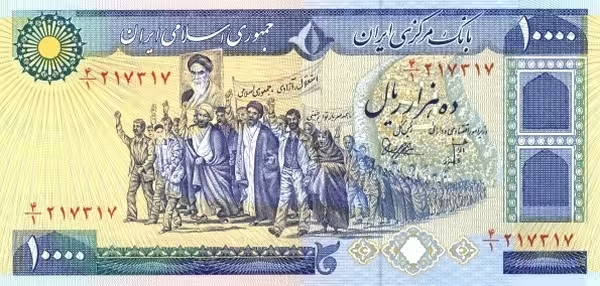
Monetary stability is rarely just a matter of macroeconomic ledger sheets; it is an ideological covenant between a state and its population, visually proclaimed upon paper currency. In the case of modern Iran, the physical banknote has served as both a propaganda canvas and a ledger of geopolitical shock. Over the course of a century, the currency transformed from a silver-backed Imperial issue into one of the lowest-valued monetary units in international trade. The shifts in purchasing power have continually forced monetary authorities to alter paper denominations, introducing ever-larger face values while redesigning decorative motifs to project political resilience amid structural fiscal stress.
Understanding the structural decline of Iran's national currency requires examining the intersection of political transformation and graphic iconography. When governments experience hyperinflation, war, or trade isolation, their paper currency exhibits identifiable visual symptoms: portraiture is replaced or obscured, denominations add logarithmic clusters of zeros, security devices become defensive, and allegories pivot from imperial majesty to martyrdom and economic self-sufficiency. By examining the visual history of the rial against the backdrop of its dollar exchange parity, one witnesses how external sanctions, macroeconomic mismanagement, and systemic oil reliance inscribed themselves directly onto Persian paper money.
Key facts
- 1932 reform: The modern Iranian rial officially replaced the Qajar qiran under Reza Shah Pahlavi (r. 1925–1941).
- Pre-revolutionary parity: The exchange rate stood at approximately 70.5 rials per United States dollar throughout the mid-1970s.
- Iconoclastic overprints: The revolutionary government physically defaced royal portraits on existing banknotes using intricate geometric lattice surcharges in 1979.
- War of attrition: The 1980–1988 Iran-Iraq War expanded the domestic money supply, initiating chronic double-digit inflation.
- Sanctions shock: Multilateral United Nations Security Council and unilateral Western sanctions post-2006 severed Iran from global clearing systems.
- Denomination explosion: Maximum note values rose from 10,000 rials under the monarchy to 1,000,000-rial Iran Cheque notes by 2020.
- Toman transition: The Central Bank of Iran (Bank Markazi) introduced dual-denominated notes in 2020 to de-emphasize four trailing zeros.
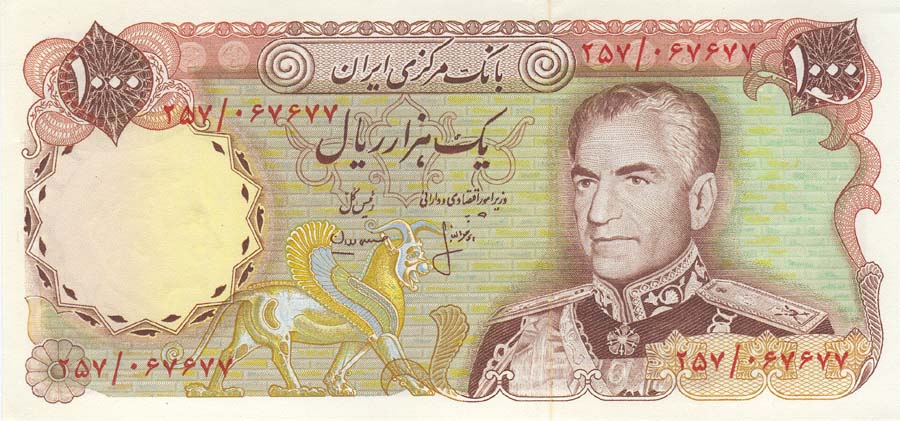
Iranian rial to USD history: an iconographic timeline of monetary decline
The historical trajectory of the rial's international value can be systematically divided into five distinct numismatic and macroeconomic epochs. Throughout these phases, the visual program of the currency was repeatedly overhauled by the central monetary authority, Bank Markazi Iran (established 1960), reflecting shifts in sovereign backing, institutional alliances, and external commercial shocks.
| Historical Epoch | Approximate Parity (Rials per 1 USD) | Dominant Iconographic Motifs | Primary Drivers of Value Shift |
|---|---|---|---|
| Late Pahlavi Golden Era (1960–1978) | ~70 – 75 | Imperial bust of Mohammad Reza Pahlavi, Persepolis reliefs, industrial modernization | Crude oil windfalls, Bretton Woods alignment, state-led industrialization |
| Revolution & Transition (1979–1981) | ~100 – 140 | Overprinted stamps, defaced royal watermarks, geometric star screens | Capital flight, nationalization of commercial banks, political upheaval |
| War of Attrition (1981–1988) | ~140 – 1,000 (free market) | Revolutionary volunteer fighters, Dome of the Rock, anti-imperial slogans | Defense expenditures, devastated oil infrastructure, fiscal deficit monetization |
| Post-War Reconstruction (1989–2005) | ~1,200 – 9,000 | Portrait of Ruhollah Khomeini, hydro-electric dams, classical architectural heritage | Unified exchange rate attempts, structural adjustment, chronic inflation |
| Sanctions & Hyper-Inflation (2006–Present) | Escalating past 50,000 (official) | Nuclear energy motifs, satellite launches, faded zeros for redenomination | Multilateral asset freezes, SWIFT disconnection, currency substitution |
Under the reign of Mohammad Reza Pahlavi (r. 1941–1979), the rial maintained remarkable formal parity with the United States dollar, fluctuating narrowly around seventy to seventy-five rials. The imagery of this period, engraved by prestigious European security printers such as Thomas De La Rue & Company and Giesecke+Devrient, prioritized dynastic legitimacy. Banknotes prominently featured the monarch's profile in Western-style military regalia or ceremonial imperial vestments, flanked by ancient Achaemenid and Sasanian ruins. These visual references deliberately anchored the regime's modern petrodollar wealth to the historical legacy of Cyrus the Great and Darius I, signalling to global currency markets that the currency was tied to an enduring, modernizing monarchy.
Following the collapse of the monarchy in February 1979, the institutional backing of the currency dissolved. Massive capital flight occurred as affluent elites fled the country, driving the street valuation of the rial sharply downward against foreign hard currencies. The newly established revolutionary government lacked the immediate logistical capacity to print entirely new banknote series, resulting in an extraordinary phase of transitional numismatics that directly mapped political rupture onto existing notes.
Why is the Iranian rial so weak? War, revolution, and iconographic rupture
To answer why the Iranian rial is so weak today, one must trace the structural disintegration of its domestic fiscal discipline starting in 1979. The revolutionary transition disrupted crude oil extraction, the primary source of foreign exchange reserves. When the Iraqi armed forces under Saddam Hussein invaded western Iran in September 1980, the Iranian government was thrust into an eight-year war of attrition that devastated refinery hubs like Abadan and depleted sovereign reserves.
During this crisis, Bank Markazi turned to the central printing press to fund military logistics, food subsidies, and an expanding public-sector apparatus. This sustained monetary expansion, coupled with international trade embargoes following the United States embassy hostage crisis, severed the rial from normal global balance-of-payments mechanisms. The free-market value of the rial plunged, creating a widening gulf between the state's artificial official exchange rate and actual market prices.
The visual program of the war years abandoned imperial portraiture in favor of ideological mobilization and religious sanctification:
- Defacement and Overprinting: In 1979 and 1980, millions of Pahlavi banknotes received complex mechanical overprints. A black or red geometric grill pattern (shamseh) or the new national emblem was stamped directly over the face of the deposed Shah, deliberately obliterating the royal profile while retaining the currency's transactional validity.
- Watermark Obfuscation: The imperial lion and sun (Shir-o-Khorshid) and royal watermarks were neutralized using heavy dark ink, reflecting the state's determination to purge imperial visual culture even before new paper stock could be milled.
- The Holy Defense Paradigm: New banknote series issued between 1981 and 1985 depicted mass mobilizations of combatants, armed revolutionary guardsmen holding assault rifles, and Islamic architectural sites such as the Kaaba in Mecca and the Dome of the Rock in Jerusalem.
These designs served to sacralize economic sacrifice. Rather than guaranteeing convertibility into precious metals or hard foreign currencies, the banknote was visually repositioned as an ideological voucher in a state of continuous military siege. As military spending consumed over a third of government expenditure, the rial's domestic purchasing power steadily eroded.
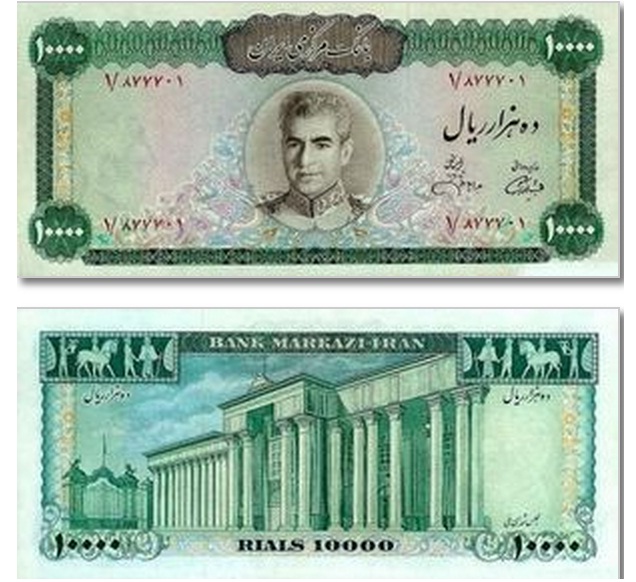
Hyper-denominations: how inflation altered the graphic design of rial notes
Following the 1988 ceasefire with Iraq, Iran entered a protracted reconstruction era that failed to curb inflationary pressures. Reconstruction borrowing, structural deficits, and an opaque dual exchange-rate system fostered systemic monetary expansion. By the mid-1990s, annual inflation surpassed 45 percent, destroying the utility of low-denomination fractional currency (dinar) and rendering 100, 200, and 500-rial paper notes obsolete.
Bank Markazi responded by escalating the denominations of its paper currency, fundamentally altering banknote typography, graphic density, and layout balance:
- Chromatic and Scale Compression: Early high-value notes like the 10,000 rials featured expansive margins, complex guilloche borders, and generous white space. As printing presses scrambled to output larger denominations, graphic layouts became densely packed, employing darker, cost-effective intaglio printings to deter local counterfeiting.
- Logarithmic Zero Multiplication: By 2000, Bank Markazi introduced the 20,000-rial note, followed rapidly by 50,000 rials (2007) and 100,000 rials (2010). The geometric composition of these notes had to accommodate long strings of zeros across both Western Arabic and Eastern Arabic numeral formats, requiring graphic designers to shrink font baselines to avoid crowding out architectural vistas.
- Introduction of Central Bank Checks: When official banknote printing could not legally keep pace with spiraling inflation, the Iranian government authorized the issuance of Iran Cheque bearer notes in denominations of 500,000 and 1,000,000 rials. Legally classed as cashier drafts rather than legal tender notes, these instruments circulated as de facto paper currency, signaling that the formal banknote regime was unable to meet daily cash transaction requirements.
From monarchical legitimacy to ideological monuments: visual motifs of isolation
The iconography of Iran's post-reconstruction banknotes shifted from battlefield themes to representations of infrastructural self-sufficiency and technological achievement. As international isolation intensified following Iran's uranium enrichment disputes in the mid-2000s, the visual repertoire of the rial transformed into an overt declaration of resistance against foreign diplomatic pressure.
On the obverse of nearly all standard post-1992 denominations (from 1,000 to 100,000 rials), the portrait of Ayatollah Ruhollah Khomeini became the obligatory standard. Rendered in sober academic portraiture, this image functioned as a uniform seal of theological and state authority, replacing the dynamic series of portraits characteristic of the Pahlavi dynasty. Unlike the regal crown and ermine mantle of the previous regime, Khomeini was depicted in austere clerical robes (aba) and turban (ammameh), gazing outward with a restrained, contemplative expression designed to symbolize incorruptibility.
The reverses of these notes, however, tell an evolving story of economic nationalism:
- Technological Autarky: The 50,000-rial note issued in 2007 created global headlines by featuring an atomic orbital model circling an atomic nucleus, placed alongside a prophetic Hadith praising Persian intellectual prowess. This design served as a defiance of Western diplomatic pressure, explicitly linking the depreciating currency to the state's controversial nuclear program.
- Scientific Modernity: Subsequent issues featured the Omid domestic satellite, the Damavand peak, biotechnology laboratories, and medical institutions, attempting to convince a domestic public suffering from high inflation that state investment was yielding technological advancement.
- Architectural Sanctification: Traditional historical sites—such as the Tomb of Hafez in Shiraz, the Imam Reza Shrine in Mashhad, and the historic bridges of Isfahan—were retained to maintain cultural continuity and tap into broader Iranian national identity.
Yet, despite these sophisticated engravings, the international currency markets responded not to symbolic declarations of self-sufficiency, but to balance-of-payments fundamentals. The comprehensive sanctions regimes enacted by the United States and the European Union after 2010—specifically targeting the Central Bank of Iran and crude petroleum exports—paralyzed the country's foreign currency inflows. With oil revenues blocked from repatriating through regular global clearing channels, the rial's street value fell precipitously from roughly 10,000 per dollar in 2010 to catastrophic lows over the following decade.
Sanctions, oil dependence, and the shift to fractional toman iconography
By 2019, the disparity between nominal rial values and everyday commerce had reached an untenable threshold. In daily parlance, Iranian citizens had long abandoned the rial, calculating all retail purchases in toman (a traditional unit of account equal to ten rials). The accumulation of zeros had corrupted accounting ledgers, overloaded electronic database columns, and diminished public confidence in the national monetary unit.
In response, the Iranian parliament (Majlis) approved a currency reform bill proposing the removal of four zeros from the national currency and designating the toman as the official monetary unit. While legislative and bureaucratic delays prevented an immediate, total redenomination, Bank Markazi initiated a fascinating transitional iconographic experiment on its newly minted generation of banknotes and Iran Cheques.
On these modern notes (specifically the 50,000-toman and 100,000-toman promissory issues released around 2020), graphic designers utilized a subtle typographic hierarchy. The first four digits of the denomination (e.g., "50" or "100") were printed in bold, heavily pigmented intaglio ink, while the trailing four zeros ("0,000") were printed in faint, barely legible ghosted outlines. This visual sleight-of-hand trained the public eye to read the note in toman rather than rials, preparing the monetary consciousness of the populace for eventual structural redenomination without incurring the monumental logistical cost of an immediate currency recall.
The contemporary rial stands as a physical artifact of structural macroeconomic distortion. Its designs depict majestic universities, sacred pilgrimage sites, and satellite communication dishes, yet its paper quality and hyper-inflated denominations chronicle a relentless decline in international purchasing power driven by isolation, war, sanctions, and monetary expansion.
Frequently asked questions
What is the historical origin of the Iranian rial?
The modern Iranian rial was introduced in 1932 during the monetary reforms of Reza Shah Pahlavi, replacing the centuries-old Qajar qiran as the official currency unit of Iran. Backed by silver and gold reserves, the rial established a centralized, state-controlled monetary system overseen by Bank Melli Iran before the creation of Bank Markazi in 1960.
What caused the dramatic collapse in the Iranian rial to USD history?
The collapse in the Iranian rial to USD history was precipitated primarily by the 1979 Islamic Revolution, the financial drain of the 1980–1988 Iran-Iraq War, structural oil reliance, and crippling international financial sanctions. These factors continuously restricted Iran's foreign exchange earnings, compelling monetary authorities to run severe fiscal deficits and print currency, which sparked decades of compounded domestic inflation.
Why is the Iranian rial so weak compared to other global currencies?
The Iranian rial is structurally weak due to chronic macroeconomic imbalances, double-digit annual inflation, high money supply growth, and extensive international sanctions that disconnect Iran from global banking networks. Lacking diverse foreign direct investment and facing restrictions on crude oil exports, the currency faces constant downward pressure from domestic capital flight and persistent demand for foreign hard currencies.
How did banknote designs reflect the transition from the Pahlavi monarchy to the Islamic Republic?
Banknote iconography reflected this political shift through immediate censorship and ideological replacement. In 1979, the revolutionary regime used intricate mechanical overprints to block out portraits of Mohammad Reza Pahlavi on existing currency, before issuing new series featuring armed revolutionary militia, holy shrines, Ayatollah Ruhollah Khomeini's portrait, and symbols celebrating domestic technological self-reliance.
What is the difference between the Iranian rial and the toman?
The Iranian rial is the official legal currency unit used by the central bank and international markets, while the toman is a traditional super-unit of account equal to ten rials that is almost universally used in everyday domestic commerce. Due to excessive inflation, Iranians quote prices in toman to eliminate an unnecessary zero from verbal transactions, prompting current legislative efforts to make the toman the legal standard.
Why did Iran introduce high-denomination Iran Cheque notes?
Iran introduced high-denomination Iran Cheque bearer drafts because rapid inflation rendered standard legal tender banknotes insufficient for ordinary commercial trade. Classed as guaranteed bank checks rather than legal tender paper notes, these denominations (ranging from 500,000 to 2,000,000 rials) allowed the central bank to bypass statutory legislative approvals required for printing new banknote series while injecting essential liquidity into cash-strapped markets.
Conclusion
The trajectory of the Iranian rial to USD history illustrates how an economy's geopolitical realities and institutional health leave visible traces upon its physical currency. From the crisp, London-engraved imperial portraits of the early twentieth century to the overprinted and zero-laden issues of the modern era, the rial's visual identity has continuously adjusted to political upheavals, military conflicts, and diplomatic confrontations. Numismatists and economic historians alike can trace the narrative of modern Iran not merely through its treaties and trade balances, but through the changing symbols, obscured watermarks, and escalating denominations of its paper money.
Sources & further reading
- Bank Markazi Iran (Central Bank of Iran). The History of Money and Banking in Iran. Central Bank Publications, Tehran.
- Encyclopaedia Iranica. "Coins and Coinage: The Pahlavi and Post-Revolutionary Periods." Columbia University, New York.
- Clawson, Patrick. Eternal Iran: Continuity and Chaos. Palgrave Macmillan, London.
- Amuzegar, Jahangir. Managing the Islamic Economy: The Iranian Experience. State University of New York Press, Albany.
- American Numismatic Society. Sylloge of Modern Islamic and Middle Eastern Paper Money. ANS Collections and Research, New York.