Plate 01
Republic-era 20 Rial Coin
- Date
- 1980s
- Metal
- Bronze
- Weight
- ~5 g
ObverseIslamic Republic emblem.
ReverseMonument commemorating the 3rd anniversary of the Islamic revolution.
Representative of early-Republic circulation coinage.
Post-revolution coinage replaced the Lion-and-Sun with floral and architectural motifs. Banknotes feature Khomeini portrait from 1992, and have ranged from 100 to 1,000,000 rial. Toman (10 rial) is being reintroduced as the official unit in 2020s currency reform.
Islamic Republic coins and banknotes are the money of Iran since 1979: portraits and royal emblems removed, replaced by calligraphic inscriptions, the tulip-shaped Allah emblem, revolutionary imagery and shrine architecture, in cupro-nickel and steel rials and in banknotes whose face values climbed from 100 to 1,000,000 rials.
| Period | 1979 CE – present |
|---|---|
| Currency unit | Rial (10 rials = 1 toman in everyday speech) |
| Coin metals | Cupro-nickel, brass-plated and nickel-plated steel |
| Note range | 100 rials to 1,000,000 rial iran cheque |
| Common motifs | Allah emblem, Imam Reza shrine, Ka'ba, Azadi Tower |
| Dating | Solar Hijri (add 621) on coins; AH on some notes |
The first money of the Islamic Republic was Pahlavi money with the Shah's face obliterated. Existing note stocks were overprinted — an arabesque block over the portrait, sometimes a Lion-and-Sun watermark left visible — and circulated while new designs were prepared.
These transitional overprints are the most collected single area of modern Iranian paper. Varieties depend on the overprint pattern, the underlying note series and denomination, and whether the watermark portrait was also treated.
New coinage removed the royal portrait entirely. The obverse carries the tulip-shaped Allah emblem adopted in 1980 and the date in the Solar Hijri calendar; reverses show the shrine of Imam Reza at Mashhad, the Ka'ba, the Aqsa mosque, Azadi Tower, or a floral wreath with the denomination.
Banknotes follow the same programme, with an added documentary strand: designs commemorating the revolution, the Iran–Iraq war, the Islamic Consultative Assembly and scientific achievement. Later series carry portraits of Ayatollah Khomeini, first appearing in the 1980s and standard on higher denominations since.
The story of this coinage is denominational inflation. Coins of 1, 2 and 5 rials, ordinary in the 1980s, were abandoned as their metal value overtook their face value; the circulating range moved to 500, 1,000, 2,000 and 5,000 rials.
On paper the same pressure produced first the 100,000 rial note and then the iran cheque instruments of 500,000 and 1,000,000 rials, which function as currency in practice. A long-running redenomination programme proposes replacing the rial with the toman at 1:10, formalising what Iranians already say in shops.
This is the most accessible field in Iranian numismatics: nearly everything can be assembled in uncirculated condition at low cost, and a full date run of a coin type is a realistic project rather than a lifetime's work.
Where value does appear it is specific: overprinted transitional notes, low serial numbers, replacement notes, commemorative issues struck in small numbers, and mint errors. For notes, grade is decisive — crisp uncirculated examples are worth multiples of the same design with folds.
Because the material is recent and abundant, provenance matters less here than anywhere else in the catalogue, which makes it a good starting point for new collectors before moving back into hand-struck and ancient series.
Early Republican coins (1979–1991) retained the Lion-and-Sun briefly, then adopted Imam Reza Shrine, floral patterns, and Qur'anic phrases.
Banknotes: pre-1992 'overstamped' Pahlavi notes (Khomeini portrait covering Shah's); 1992 onwards new designs feature Khomeini.
The 100,000 rial cheque-note and the 'Iran cheque' (500,000 rial) function as everyday currency given inflation.
2020 redenomination law: 1 toman = 10,000 rial (planned).
ObverseIslamic Republic emblem.
ReverseMonument commemorating the 3rd anniversary of the Islamic revolution.
Representative of early-Republic circulation coinage.
Transitional issue, Islamic Republic
ObversePahlavi-era Shah portrait obscured by an Islamic arabesque or Khomeini overprint.
ReverseOriginal Pahlavi vignette retained.
Following the 1979 revolution, existing stocks of high-denomination Pahlavi notes were over-printed to remove the Shah's image while replacement notes were designed.
ObversePortrait of Ayatollah Khomeini.
ReverseMadrasa Faiziyeh, Qom.
The 100 rial note became the workhorse low denomination of the post-revolutionary era; later supplanted by the coin.
ObverseFriday prayer congregation at Tehran University.
ReverseHoly shrines / Qur'anic verse.
Second IR series, with revolutionary imagery replacing royal portraits.
ObverseScene of revolutionary martyrs or Friday prayer.
ReverseHoly shrine of Imam Reza, Mashhad.
Second-series IR high denomination; replaced the over-printed Pahlavi notes.
ObverseFriday prayer congregation, with revolutionary slogans.
ReverseHoly shrine vignette.
Highest denomination of the second IR series, issued before the 1992 Khomeini-portrait redesign.
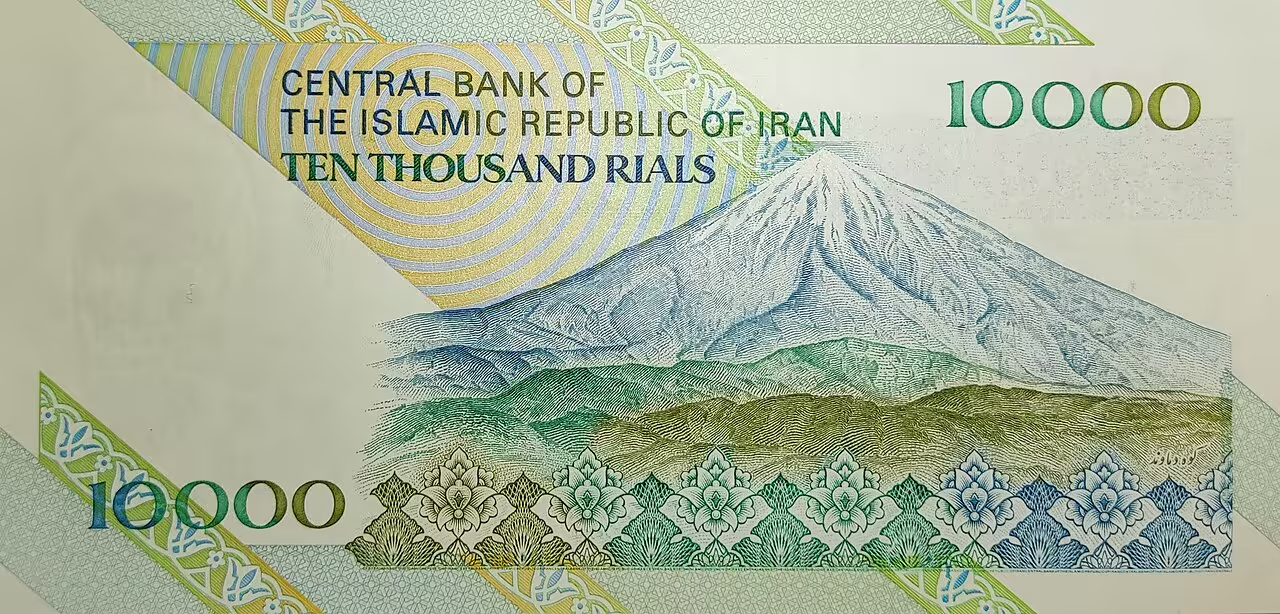
ObversePortrait of Ayatollah Khomeini.
ReverseMount Damavand peak.
Workhorse banknote of the modern era, reissued repeatedly with security upgrades.
ObversePortrait of Ayatollah Hassan Mudarres — constitutional cleric and martyr of the Reza Shah era.
ReverseMajles (Iranian Parliament) building, Baharestan, Tehran.
Early Republican-era note before the universal switch to the Khomeini portrait in 1992; Mudarres was chosen as a Shia-clerical symbol of constitutionalist opposition.
ObverseKhomeini portrait; new dual denomination 'Toman' marking introduced under the 2020 redenomination law.
ReverseArchitectural vignette (varies by denomination).
Phase-one of the planned 1:10,000 redenomination — banknotes carry both 'rial' (legal) and 'toman' (popular) values during transition. Full redenomination implementation was repeatedly delayed.