In short
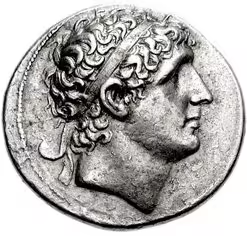
Seleucid coins are the Greek-style silver tetradrachms, drachms and bronzes struck across Iran and Mesopotamia by the successors of Seleucus I between 312 and roughly 141 BCE — royal portrait on the obverse, a seated Apollo or Zeus on the reverse, and Greek legends naming the king as BASILEOS.
A Greek monetary system on Iranian soil
Seleucus I, one of Alexander's generals, took the eastern half of the conquered empire and kept Alexander's monetary machinery: the Attic weight standard, Greek legends and portrait coinage. For the first time the Iranian plateau used money that showed a human ruler's face — a decisive break from the anonymous archer of the daric.
The system was deliberately uniform. A tetradrachm struck at Ecbatana was interchangeable with one from Antioch, which is precisely what a kingdom stretching from the Aegean to Bactria needed. Bronze denominations handled local markets and are far more common as site finds than the silver.
Reading a Seleucid coin
The obverse gives a diademed portrait, usually facing right, of the reigning king — Seleucus I, Antiochus I with his distinctive angular features, Antiochus III with a hard realistic profile, Antiochus IV with a radiate crown claiming divinity.
The reverse legend runs vertically in two lines: BASILEOS (of King) and the royal name in the genitive, often with an epithet such as MEGALOU (the Great) or EPIPHANOUS (God Manifest). Monograms and control marks in the field identify the mint and the issuing magistrate, and are the key to attribution.
The eastern mints
Seleucia on the Tigris was the great eastern mint and the administrative heart of the kingdom, founded as a deliberate replacement for Babylon. Ecbatana (Hamadan) served the Iranian highlands, Susa the southwest, and Persepolis-area workshops issued locally.
From about 250 BCE the empire begins to lose the east — Bactria goes first, then Parthia. By 141 BCE Mithridates I of Parthia has taken Seleucia, and Seleucid coinage in Iran ends. Parthian tetradrachms deliberately copy Seleucid design conventions, which is why the two series are so often confused.
Value, grading and what to avoid
Common bronzes are inexpensive and are the natural entry point. Silver drachms of the major kings are affordable in worn grade; well-centred tetradrachms with strong portraits, and issues of the eastern mints, carry real premiums.
Two cautions dominate the market. First, tooled and smoothed portraits: any surface that looks unnaturally sharp against a corroded field deserves scrutiny. Second, modern struck copies of Antiochus IV and Antiochus III tetradrachms, which usually betray themselves on weight (a genuine Attic tetradrachm is close to 16.8–17.2 g) or on a die axis that does not match published examples.