About the archive
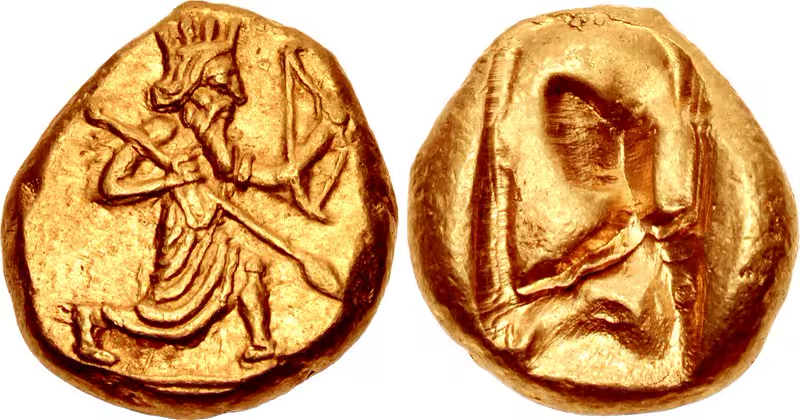
Persian Treasury is an educational catalogue of Persian and Iranian numismatics — the coins and paper money of the lands long called Iran-zamin, from the pre-monetary silver of the Median plateau to the polymer banknotes of the contemporary Islamic Republic. Our intent is to make the long, layered story of Iranian money intelligible to readers who arrive without any prior numismatic training, while still being precise enough that students, collectors and museum researchers can use the site as a working reference.
The archive is organised by dynasty across eleven eras: Pre-Achaemenid Iran, the Achaemenid Empire, Seleucid Persia, the Parthian (Arsacid) realm, the Sasanian Empire, the early Islamic centuries and their Iranian dynasties (Tahirid, Saffarid, Samanid, Buyid, Ghaznavid, Seljuq), the Mongol Ilkhanate and Timurid era, the Safavids, the Afsharid and Zand interlude, the Qajars, the Pahlavis, and the Islamic Republic. Each entry records the ruler, denomination, weight, mint, iconography of obverse and reverse, language and script of the legends, and a primary reference — favouring published scholarship (SNS, Sellwood, Album, Göbl, Carradice) and institutional databases (American Numismatic Society, British Museum, Encyclopædia Iranica) over commercial price-guides.
Editorial principles
Persian Treasury is independent and non-commercial. We do not buy or sell coins, do not appraise specimens, and do not accept paid placements in the catalogue. Where a private collector or dealer's image has been used, this is acknowledged in the source link and the licence noted. Wikimedia Commons images are used under their stated CC-BY or public-domain terms. The site is funded by its editors and runs without advertising.
We try to write in plain, modern English. Where a technical term is unavoidable — siglos, frataraka, mihrab, kalima, Pahlavi, mihrab — it is glossed on first use and collected in the numismatic glossary. Persian readers can find a parallel Persian-language version of every page through the language switch in the header; the Persian and English texts are kept in step rather than machine-translated.
How an entry is built
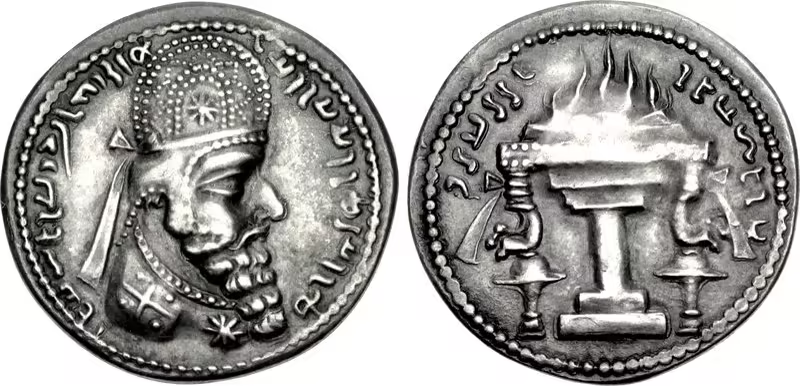
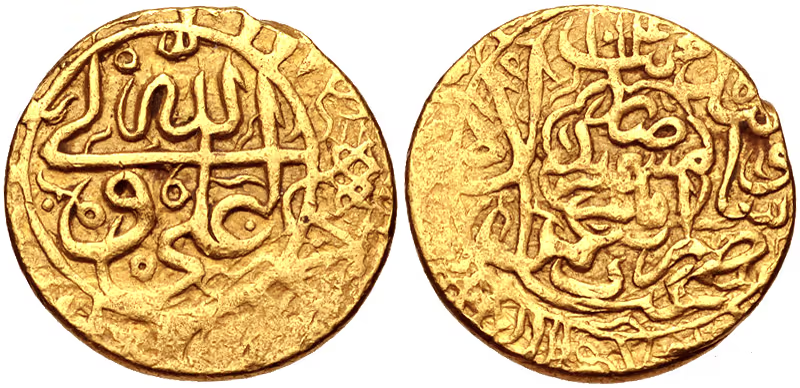
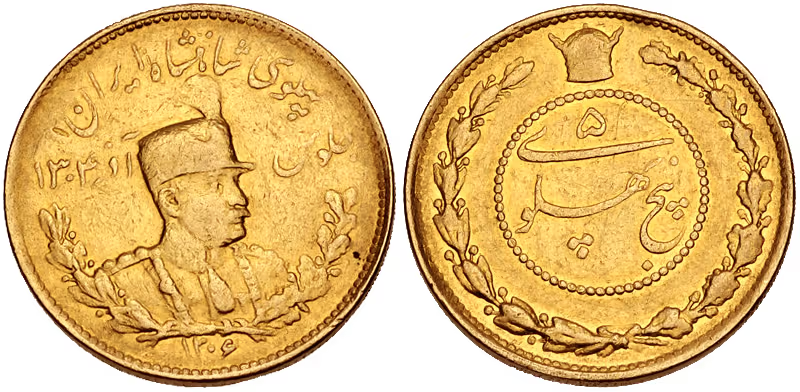
A typical catalogue entry rests on three sources: the institutional record (museum accession or auction-house attribution), the scholarly literature for the type, and the historical context of the issuing authority. Where the three disagree we record the more cautious reading and flag the disagreement. Dates given as "c." are conservative; uncertain attributions are marked with a question mark rather than silently smoothed over. Weights are cited from published specimens, not theoretical standards — Sasanian drachms claim a 4.0 g target but actually circulate between 3.9 and 4.2 g, and we say so.
Iconography is described in the order an examiner would scan a coin: central design, then encircling legend, then border, then exergue. The obverse is the side bearing the principal authority (a portrait, a name, or a religious profession); the reverse is the side bearing the secondary type (a fire altar, an archer, a Qur'anic citation). For machine-struck issues we also note the engraver where known — most Qajar machine dies are signed in tiny Arabic letters near the rim.
Why Persian coins matter
Persian coinage is one of the longest continuous monetary traditions in human history. The gold daric of Darius I, struck around 515 BCE, is among the earliest coins issued as a deliberate instrument of imperial policy rather than a local civic emblem. The Sasanian drachm, struck without significant change from Ardashir I in 224 CE to Yazdegerd III in 651 CE, is the most numerous surviving silver coinage of late antiquity. The Umayyad caliph Abd al-Malik's coinage reform of 696 CE replaced figurative imagery with pure epigraphy and set the visual grammar of Islamic money for more than a thousand years — a grammar still legible on modern Iranian rial notes.
Coins are also, uniquely among historical objects, both miniature artworks and primary documents. A single Sasanian drachm preserves the king's portrait, his exact title, the mint city, the regnal year and (often) the workshop officer's mark; a Safavid abbasi preserves the Shi'a profession of faith and the calligrapher's school. Coins travelled — Samanid dirhams have been excavated in Viking Sweden — so they are also evidence of trade networks that written sources do not record. The aim of this archive is to make that evidence accessible without diluting it.
Scope and what is not here
Persian Treasury covers coinage and paper money struck or issued by authorities ruling parts of historical Iran. We include neighbouring numismatic traditions — Greco-Bactrian, Kushan, Elymais, Characene — where they bear directly on Iranian history, but they are not exhaustively catalogued. Tokens, jetons, medallions, military medals and orders, banking scrip, hawala receipts, modern bullion rounds and commemorative non-circulating issues are mentioned only where they illuminate a circulating issue. Forgeries are described when they are historically important (Safavid forgeries of Mughal rupees, for example) but are not catalogued as types.
For authenticated examples and very high-resolution plates, follow the source link on each catalogue entry to the issuing museum or to the auction record. Where the only available image is a stylised photograph or a reconstruction, this is stated. We do not knowingly publish unattributed images and we welcome corrections; please use the contact page for image-rights inquiries or factual disputes.
Using the site
New readers usually find it easiest to begin with the timeline for a chronological overview, then jump into a specific era from the full catalogue. The mints page is a geographic index — useful if you have a coin and only the mint city is legible. The rulers index works the other way: if you can read the king's name but not the date or denomination, start there. Banknote collectors will want the dedicated banknotes page, which arranges Iranian paper money from the 1890 Imperial Bank of Persia notes through the latest Islamic Republic issues.
Every page is bilingual (English and Persian) and every coin entry can be deep-linked. Pages are designed to print legibly: an A4 print of an entry should be usable as a handout in a classroom or as a reference at the cabinet.
Our mission
The mission of Persian Treasury is simple to state and slow to finish: to make the full monetary history of Iran-zamin — every dynasty, every metal, every script — legible to a general reader in both English and Persian, backed at every point by a citable source. We think of the site as a bridge between two audiences that too rarely read each other's material: the academic numismatic literature, which is precise but scattered across journals, museum bulletins and out-of-print monographs; and the collecting community, which is enthusiastic and image-rich but frequently repeats undocumented lore. Our job is to sit between the two, translate the scholarship into plain prose, and correct the lore where it is wrong.
Editorial standards
Every factual claim on this site should be traceable to a named source: a museum accession record, a peer-reviewed die study, an auction house's cataloguing note, or a primary text (an inscription, a chronicle, a government gazette). We prefer institutional and academic sources to dealer marketing copy, and we prefer a documented specimen to a theoretical type description. When scholarship is genuinely unsettled — the precise mint attribution of certain late Sasanian issues, for instance, or the earliest date of Achaemenid coinage — we say so rather than picking a side for narrative convenience. Corrections are made promptly when readers point out an error, and we keep no page permanently "finished": entries are revised as better photographs, new hoards, or new scholarship become available.
We separate description from valuation. Persian Treasury records what a coin or note is — its metal, weight, mint, iconography, and historical context — and only rarely and cautiously touches what it is worth, since prices move quickly and depend on grade, provenance and market conditions that a static reference page cannot track responsibly. Where we mention value it is to illustrate relative rarity, not to appraise a specific specimen.
Sourcing methodology
Our research workflow starts with the standard reference for the period — the multi-volume Sylloge Nummorum Sasanidarum (SNS) for Sasanian coinage, Stephen Album's Checklist of Islamic Coins for the Islamic centuries, David Sellwood's Parthian typology, Ian Carradice's work on Achaemenid coinage — and cross-checks the type against at least one institutional collection database, typically the American Numismatic Society's Mantis catalogue or the British Museum's collection online. For rulers and mints not well covered by a single monograph, we consult Encyclopædia Iranica and the relevant museum bulletins (Numismatic Chronicle, Iranica Antiqua, Studia Iranica). Auction archives — CNG, Roma Numismatics, Heritage, Künker, Stephen Album Rare Coins — are used to confirm weights, diameters and die axes on documented specimens, and occasionally to illustrate a type for which no museum photograph is publicly available; in every such case the auction house is credited by name.
For modern paper money we rely on the issuing institutions' own archives (Bank Melli Iran, Bank Markazi's Money Museum), the printing houses' specimen records where published, and the standard catalogue numbering of the Krause Standard Catalog of World Coins and the Linzmayer Banknote Book, which most collectors and dealers use as a common reference language.
How we transliterate
Persian and Arabic names can be romanised in many defensible ways, and inconsistency across sources is one of the most common sources of confusion for newcomers to the field. Persian Treasury follows, as closely as practical, the transliteration conventions of Encyclopædia Iranica: Khosrow rather than the Hellenised Chosroes; Shapur rather than Sapor; Naser al-Din rather than Nasruddin; Abbas rather than Abbass. Where a ruler or dynasty is overwhelmingly better known in English under a different spelling — Genghis Khan rather than Chinggis Khan, for instance — we use the familiar form and note the more technical transliteration in parentheses on first mention. Arabic honorifics and titles (Shah, Malik, Amir al-Mu'minin) are kept in italics and glossed at first use. We avoid diacritics in running text for readability but preserve them in direct quotations of scholarly titles and in the glossary.
Image licensing
Photographs on this site are used under one of three licences, each indicated on the image credit or the linked source: Wikimedia Commons images under their stated CC-BY-SA, CC-BY, or public-domain licence (the great majority of our historical plates); auction-house or dealer photographs used with attribution under fair-use principles for educational, non-commercial identification purposes, always linked back to the original listing; and, occasionally, images contributed directly by private collectors with their permission. We do not strip metadata or watermarks, we do not claim exclusive rights over third-party photographs, and we remove or re-credit any image on request from the rights holder. If you believe an image is misattributed or used without appropriate permission, please contact us and we will correct it promptly.
How the site is organised
The architecture mirrors how a collector actually works backwards from an object to an identification. The timeline and the eleven era pages give the chronological narrative. The catalogue is the flat, searchable index of every entry. The mints index is geographic — useful when only a mint name is legible on a coin — while the rulers index is biographical, useful when a ruler's name is legible but nothing else. The compare tool places any two catalogue entries side by side; the glossary defines recurring technical terms; the FAQ answers the questions we are asked most often; and the sources page lists the bibliography behind every claim. Every page exists in a parallel Persian edition reachable from the header's language switch.
How to cite us
Persian Treasury is written to be citable, not just readable. A general reference to the site can take the form: Persian Treasury — Persian & Iranian Coins and Banknotes, https://persiantreasury.com, accessed [date]. A citation to a specific entry should include the entry title and its deep link, e.g. "Daric of Darius I," Persian Treasury, https://persiantreasury.com/coin/daric-darius-i, accessed [date]. We ask that academic and journalistic use credit the site by name and, where possible, link back to the cited page so that readers can verify the sourcing for themselves.
A note on transliteration: rulers' names follow Encyclopædia Iranica's conventions where possible (Khosrow, not Chosroes; Shapur, not Sapor; Naser al-Din, not Nasruddin). Dates use CE/BCE; Islamic-era coins also carry AH (Anno Hegirae) where the original strike date is on the coin. Pahlavi-era coinage carries SH (Solar Hijri) regnal years, and late Sasanian issues use YE (Yazdgerd Era). Weights are in grams; diameters in millimetres; gold fineness as a percentage where attested by modern analysis.