← All eras
247 BCE – 224 CE · Iran, Mesopotamia, Armenia

Parthian (Arsacid) Empire

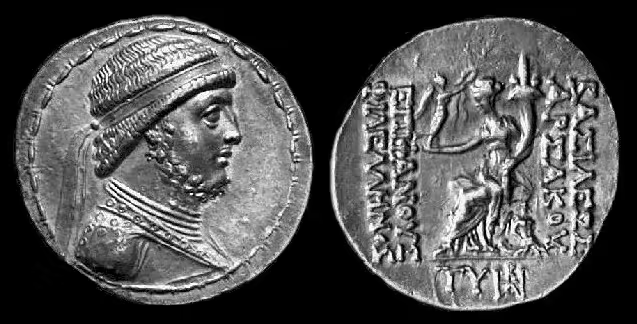
The Arsacid kings issued silver drachms and bronze chalkoi at Ecbatana, Seleucia, Susa, Mithradatkart and Rhagae. Reverse types are remarkably consistent: the seated archer Arsaces.

Historical note

Parthian drachms span ~470 years and 30+ rulers from Arsaces I to Artabanus IV. Sellwood's typology (S1–S94) remains the standard reference.

The seated archer on the reverse is the founder Arsaces, deified — a powerful dynastic statement.

Late Parthian tetradrachms from Seleucia are dated by Seleucid Era and often name the king explicitly.

The pieces

Catalogue · 9 entries

Plate 01

Mithradates I Tetradrachm

Mithradates I

Date
171–138 BCE
Metal
Silver
Weight
~4.1 g (drachm) / ~16 g (tetradrachm)
Mint
Seleucia-on-the-Tigris

ObverseDiademed bust left in Greek style.

ReverseArcher Arsaces seated on omphalos; Greek legend BAΣIΛEΩΣ ΜΕΓΑΛΟΥ.

First king to title himself 'Great King'.

Source · Commons – Mithradates I
Plate 02

Mithradates II Drachm

Mithradates II

Date
121–91 BCE
Metal
Silver
Weight
~4.0 g
Mint
Ecbatana, Rhagae

ObverseBust with tiara crown — first appearance of Parthian tiara.

ReverseArcher seated; expanded titulature 'King of Kings'.

Coinage shifts from Greek to Iranian royal imagery.

Source · Commons – Mithridates II
Plate 03

Orodes I Silver Tetradrachm

Orodes I

Date
90–77 BCE
Metal
Silver
Weight
~14 g
Mint
Seleucia on the Tigris

ObverseDiademed bust of Orodes I left, with short beard.

ReverseSeated archer Arsaces holding bow, Greek legend in margin.

Orodes I ruled in a turbulent period of Arsacid civil war. His successor Orodes II would later defeat Crassus at Carrhae (53 BCE).

Source · Commons – Orodes I tetradrachm (Munich)
Plate 04

Vologases VI Drachm

Vologases VI

Date
208–228 CE
Metal
Billon silver
Weight
~3.5 g
Mint
Ecbatana

ObverseBearded bust with high tiara, crudely engraved.

ReverseStylised seated archer; legend in degraded Greek and Aramaic.

Vologases VI was the last Arsacid king; he was overthrown by Ardashir I, who founded the Sasanian Empire.

Source · Commons – Vologases VI of Parthia
Plate 05

Phraates IV Silver Tetradrachm

Phraates IV

Date
37–2 BCE
Metal
Silver
Weight
~14 g
Mint
Seleucia-on-the-Tigris

ObverseDiademed bust of Phraates IV left, with characteristic 'wart' on the forehead and stylised curls.

ReversePhraates enthroned receiving palm-frond from Tyche of Seleucia; Greek legend with Seleucid-era date.

Phraates IV defeated Mark Antony's Parthian expedition (36 BCE) and later received the four Roman legionary standards lost at Carrhae back from Augustus (20 BCE) — a diplomatic coup commemorated on Roman coinage. His Seleucia tetradrachms are precisely dated month-by-month.

Source · Commons – Phraates IV tetradrachm (Munich)
Plate 06

Vologases I Tetradrachm

Vologases I

Date
51–78 CE
Metal
Silver
Weight
~13.5 g
Mint
Seleucia-on-the-Tigris

ObverseDiademed bust of Vologases I left, beard short and stylised.

ReverseKing enthroned receiving diadem from standing Tyche; Greek legend, Seleucid-era month and year.

Vologases I founded a new dynastic branch and is credited by Pahlavi tradition with the first systematic collection of the Avesta. His reign coincided with Rome's wars over Armenia and the Treaty of Rhandeia (63 CE).

Source · Commons – Vologases I tetradrachm, Seleucia
Plate 07

Artabanus IV Drachm

Artabanus IV (last Arsacid)

Date
c. 213–224 CE
Metal
Silver
Weight
~3.7 g
Mint
Ecbatana (Hamadan)

ObverseBearded bust of Artabanus IV facing left, wearing high tiara.

ReverseSeated archer Arsaces; degenerate Greek legend in pellet border.

Killed by Ardashir I at the Battle of Hormozdgan in 224 CE — the end of the Arsacid dynasty after nearly five centuries and the dawn of the Sasanian empire.

Source · Commons – Artabanus IV, Hamadan
Plate 08

Kingdom of Persis – Drachm of 'Darius'

Darius II of Persis (Darayan)

Date
1st century BCE – 1st century CE
Metal
Silver
Weight
~4 g
Mint
Istakhr (Persepolis area)

ObverseDiademed bust of the local king with elaborate beard, in Aramaic-Persian style.

ReverseStanding figure before a fire altar — proto-Sasanian iconography centuries before the Sasanian dynasty.

The semi-autonomous Frataraka and later kings of Persis ruled the Achaemenid homeland under Seleucid then Parthian overlordship. Their coins preserve Persian religious iconography (fire altar, royal figure) that the Sasanians would revive and standardise.

Source · Commons – Persis drachm 'Darius'
Plate 09

Elymais Tetradrachm of Kamnaskires V

Kamnaskires V of Elymais

Date
c. 54–32 BCE
Metal
Billon silver
Weight
~15 g
Mint
Seleucia on the Hedyphon (Khuzestan)

ObverseDiademed bust of the king left, with anchor symbol behind.

ReverseDiademed bust of Athena or local deity; degraded Greek legend.

The Kingdom of Elymais — successor to ancient Elam in lowland Khuzestan — minted vassal coinage under Parthian overlordship. Their stylised portraits are some of the most distinctive of the period.

Source · Commons – Kamnaskires V, Elymais