In short
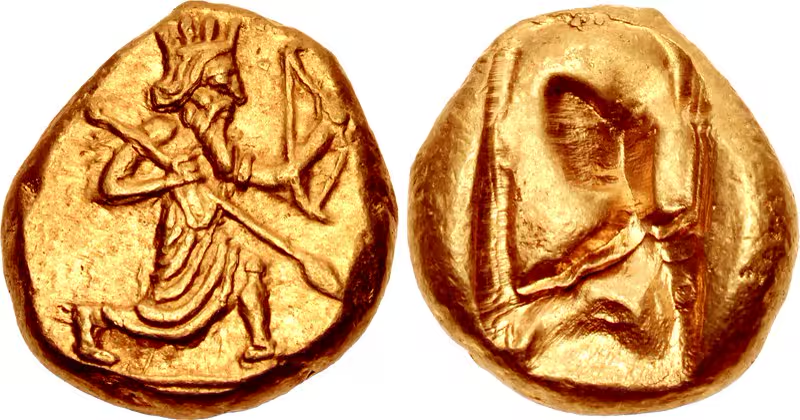
Achaemenid coins are the gold darics and silver sigloi of the Persian empire (c. 515–330 BCE), struck mainly at Sardis and showing the Great King as a kneeling archer, with an irregular punch incuse instead of a designed reverse.
The bimetallic system
Darius I created the first stable imperial bimetallic coinage: a gold daric of about 8.4 g at near-pure fineness, and a silver siglos of about 5.5 g, exchanging at twenty sigloi to the daric. The purity of the gold was famous in antiquity and is still measurable — most darics test between 95% and 98% gold.
Coinage was a western-provincial phenomenon. In the Iranian heartland weighed silver bullion remained normal, which is why darics and sigloi are found overwhelmingly in Anatolia, the Levant and Greece rather than in Fars.
Types and how to date them
Ian Carradice's five types remain the standard sequence. Type I shows a half-figure archer; Types II and III the kneeling-running archer with bow and spear; Type IV, by far the most common, adds a dagger; Type V is a late flattened style.
There is no reverse design — only an oblong incuse left by the punch. The shape of that incuse, the archer's beard and the treatment of the quiver are the practical criteria for placing a coin within the sequence.
Satrapal and provincial coinage
Alongside the imperial issues, satraps and subject cities struck their own silver: Mazaios at Babylon and Tarsus, the Phoenician mints of Sidon and Tyre with their galley types, Samaria's small silver, and the Frataraka of Persis who revived Achaemenid imagery after Alexander. These provincial coinages are where most of the variety — and most of the affordable material — sits.
Buying and authentication
Genuine darics feel heavy for their size with soft buttery surfaces; cast fakes are underweight and show a tooled, too-regular incuse. Sigloi are frequently found with banker's punch marks, which are evidence of ancient circulation rather than damage. For gold at market prices, insist on third-party attribution and a stated Carradice type.