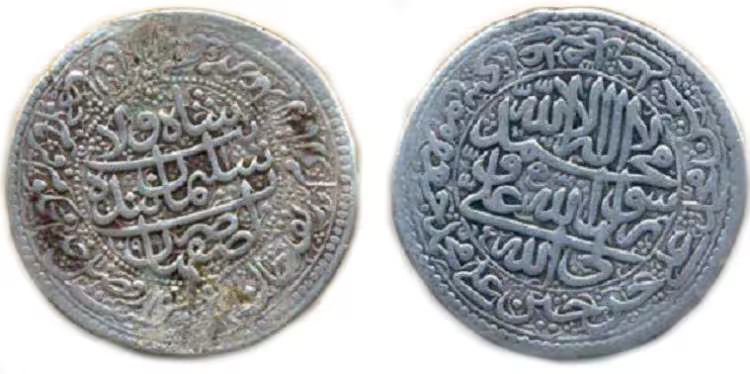
Timurid coinage
Timur (Tamerlane) and his successors struck silver tankas across an empire reaching from Anatolia to India. The coins are purely epigraphic and often strikingly beautiful: dense, architectural thuluth inscriptions inside square, hexafoil or cartouche frames that mirror the tilework of Timurid buildings.
Timur himself usually struck in the name of a puppet Chagatayid khan rather than his own, so the ruler's name on the coin is not always the man in power — a point that catches out new collectors. Herat, Samarkand and Baghdad are the mints most often seen.
Under Shah Rukh the coinage stabilises and the tanka becomes a reliable trade currency; later Timurid and Turkmen (Qara Qoyunlu, Aq Qoyunlu) issues carry it through to the Safavid takeover.
The Safavid revolution in money
Shah Ismail I proclaimed Twelver Shi'ism the state religion in 1501, and his coinage says so. The obverse carries the kalima with the addition 'Ali wali Allah' (Ali is the friend of God), and the names of the Twelve Imams frequently ring the margin. No earlier Iranian coinage makes a sectarian statement this explicit.
Shah Abbas I standardised the silver abbasi at roughly 7.7 g, with the mahmudi (half), shahi (quarter) and bisti as fractions. The unit drifted lighter across the seventeenth century, and tracking that drift is how undated or worn Safavid silver is placed in a reign.
Gold ashrafis exist but were struck largely for gifts, coronations and Nowruz distributions rather than circulation, which is why they are scarce and usually found in high grade.
Identification and common problems
Safavid flans are broad and thin, and off-centre striking that cuts away part of the marginal legend is the norm, not a defect. Judge these coins on the legibility of the central legend, the mint name and the date rather than on flan completeness.
The script itself is a dating tool: Safavid nastaliq is unmistakable next to Timurid thuluth or the later, squarer Qajar hands. Dates are AH, given in numerals in the reverse field or margin.
Common mints include Isfahan, Tabriz, Qazvin, Mashhad, Kashan, Ganja and Tiflis. Caucasian mints are scarcer and worth checking for.
Collecting notes
Safavid silver is one of the best value fields in Islamic numismatics: attractive, historically loaded, dated and mint-signed, and still inexpensive in collectable grade. A single-reign mint set of Abbas I abbasis is an achievable long-term project.
Timurid silver is scarcer and prices reflect calligraphic quality above all. For both series, prefer coins where the mint and date are fully on the flan — that single criterion drives most of the price difference between two otherwise similar pieces.