The Isfahan Mint: The Engine of Safavid Prosperity under Shah Abbas I
An in-depth exploration of the royal mint in Isfahan during the reign of Shah Abbas I, examining its role in the global silver trade and its position in the Naqsh-e Jahan.
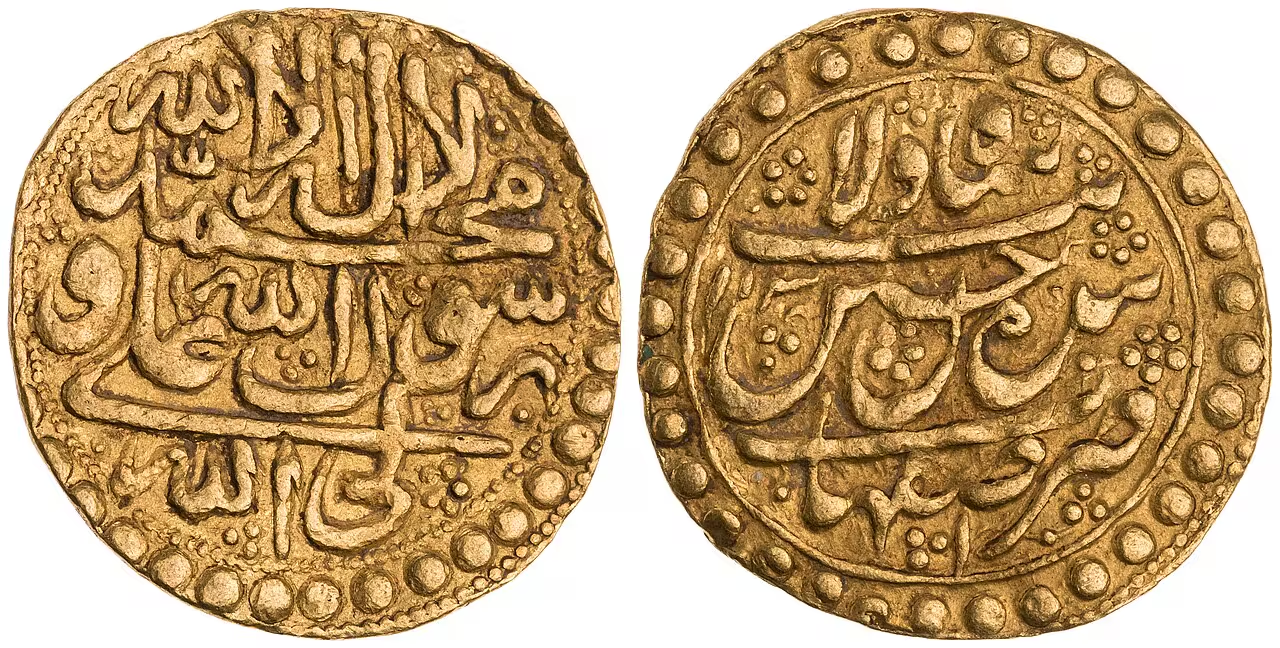
The relocation of the Safavid capital from Qazvin to Isfahan in 1598 was far more than a simple shift in administrative geography; it was a profound re-imagining of the Iranian state as a global mercantile and cultural powerhouse. At the heart of this transformation was the Dar al-Zarb, or the royal mint, an institution that translated the political stability of the Great Shah Abbas I into tangible monetary wealth. As the Safavid Empire consolidated its borders against the Ottomans to the west and the Uzbeks to the east, the Isfahan mint became the primary instrument for standardizing the Persian economy, facilitating trade with the European East India companies and managing the massive influx of silver from the New World that flowed through the Ottoman silk routes.
To understand the Isfahan mint is to understand the physical and economic architecture of the Naqsh-e Jahan square. The mint was not merely a factory for striking coins; it was a central component of the Maydan's complex ecosystem of craftsmen, state officials, and international merchants. As the empire’s premier production facility for the Abbasi, a silver denomination that would become a standard of trade across Western and Central Asia, the Isfahan mint stood as a testament to Safavid engineering and bureaucratic precision. The following exploration details how this institution operated, the technical evolution of its output, and its role in the grand design of the Safavid Golden Age.

The Architecture of Credit: The Mint in the Maydan
When Shah Abbas I redesigned Isfahan, he integrated the fiscal apparatus of the state directly into the city's ceremonial and commercial center. The mint was strategically located near the Qaysariyya Bazaar and the Ali Qapu palace, ensuring that the production of currency was under the direct supervision of the Mu'ayir al-Mamalik, or the Assayer of the Realm. This placement was deliberate; it signaled to both the local populace and foreign emissaries that the Safavid currency was backed by the absolute authority and gold-standard reputation of the Shah himself.
Within the workshops of the Isfahan mint, a highly specialized hierarchy of craftsmen labored. These included the Sakkak (die-engraver), the Zarrab (striker), and the Qat (flan cutter). Unlike the automated processes of modern numismatics, every Safavid coin was a product of manual labor. Silver ingots, often imported from Europe or extracted from regional mines, were melted into rods, cut into precise weights, and then hammered between two hand-engraved steel dies. The resulting coins were known for their distinctive broad flans and high-relief calligraphy, which often featured the Shi'ite profession of faith, distinguishing Safavid issues from the aniconic or purely titular coinage of their Sunni Ottoman and Mughal neighbors.
Silver Flux and the Abbasi Revolution
The reign of Abbas I was characterized by a fundamental shift in the Persian monetary system. Prior to his reforms, the empire utilized various debased currencies and localized weight standards that hampered large-scale trade. Abbas introduced the Abbasi, a silver coin weighing approximately 7.7 to 9.2 grams depending on the period and reform stage. This denomination became so successful that its name survived in the regional lexicon for centuries.

To manage this output, the Isfahan mint had to process enormous quantities of silver. This metal arrived in several forms:
- Spanish Reals: Large quantities of 'pieces of eight' arrived via the silk trade and maritime routes through the Persian Gulf.
- Ottoman Silver: Despite constant warfare, economic exchange with the Ottoman Empire remained a primary source of bullion.
- Domestic Recoinage: The state frequently called in older, worn coins to be melted down and reissued as high-purity Abbasis to maintain confidence in the market.
| Denomination | Metal | Average Weight (Grams) | Common Obverse Inscription |
|---|---|---|---|
| Abbasi | Silver | 7.7 - 9.3 | "The Slave of the King of Men, Abbas" |
| Mahmudi | Silver | ~2.0 - 2.5 | Varies by Provincial Mint |
| Shahi | Silver | ~1.8 - 1.9 | Kalima (Shahada) |
| Bisti | Silver | ~0.9 - 1.0 | Mint Name and Date |
Calligraphy and Legitimacy: The Mint Signatures
The coins produced at the Isfahan mint are masterpieces of Nasta'liq calligraphy. During the Safavid period, the aesthetic quality of the coinage was considered an extension of the royal library's arts. The dies were often engraved by masters who were well-versed in the proportions of classical scripts. One of the most striking features of Isfahan’s output is the 'Mint Signature' or the Zarb-i Isfahan. This was typically placed at the bottom of the reverse side, often accompanied by the year of production in the Hijri calendar.
During the peak of the Safavid period, the phrase Zarb-i Dar al-Saltana Isfahan (Struck at the Abode of the Sultanate, Isfahan) became a common sight on the reverse of the coinage. This wasn't just a geographical marker; it was a mark of prestige. A coin from the Isfahan mint was generally trusted more than those from peripheral mints due to the proximity of the central treasury and the stricter quality control measures implemented by the Shah’s personal appointees.

The Economic Impact of Mint Centralization
By centralizing a significant portion of bullion processing in Isfahan, Shah Abbas I was able to exercise unprecedented control over the national economy. This centralization allowed the state to fund its standing army, the Gholams, and finance the massive infrastructure projects that defined his reign, such as the construction of bridges, caravanserais, and the grand mosques of the capital.
However, the mint also faced challenges. The dependency on foreign silver meant that the Isfahan workshop was susceptible to global market fluctuations. When silver flows from Europe slowed due to Atlantic wars, the Dar al-Zarb in Isfahan would see a decrease in volume, forcing the Shah to occasionally lower the silver fineness, though he remained remarkably consistent in maintaining a high purity compared to most contemporary rulers.
Technological and Artistic Evolution
As the 17th century progressed, the Isfahan mint began to experiment with die sizes. Earlier Abbasis were somewhat thick and small in diameter, but later issues featured larger, thinner flans. This change allowed for more elaborate inscriptions, including poetic verses known as bayts that praised the Shah or invoked the protection of the Twelve Imams.
- Preparation: Pure silver was alloyed with a small amount of copper to increase durability.
- Casting: The alloy was cast into thin plates or strips.
- Cutting: Blanks were manually punched or cut from the strips.
- Striking: The heated blank was placed between the lower 'anvil' die and the upper 'hammer' die and struck with a heavy blow.
This manual process meant that while there was a unified 'look' to Isfahan coins, no two were perfectly identical. Researchers frequently study these minor variations to identify different 'batches' or to trace the career of specific master engravers whose subtle styles can be recognized across decades of production.
Conclusion
The Isfahan mint under Shah Abbas I was far more than a facility for metalwork; it was the heartbeat of an empire. By situating the Dar al-Zarb within the ideological and physical center of the Naqsh-e Jahan, Abbas signaled to the world that Safavid power was built on a foundation of economic integrity and artistic excellence. The massive output of silver Abbasis facilitated the Golden Age of Persian trade, enabling the silk merchants of New Julfa and the diplomats of the Safavid court to operate on the global stage with a currency that was respected from London to Kyoto. Today, the coins remaining from this era serve as miniature archives, preserving the calligraphic beauty, the religious fervor, and the sophisticated economic logic of one of history’s most remarkable dynasties. They remain the most enduring legacy of the skilled workers who once labored in the shadows of the Ali Qapu, striking the silver that fueled the dreams of the Great Shah.
