In short
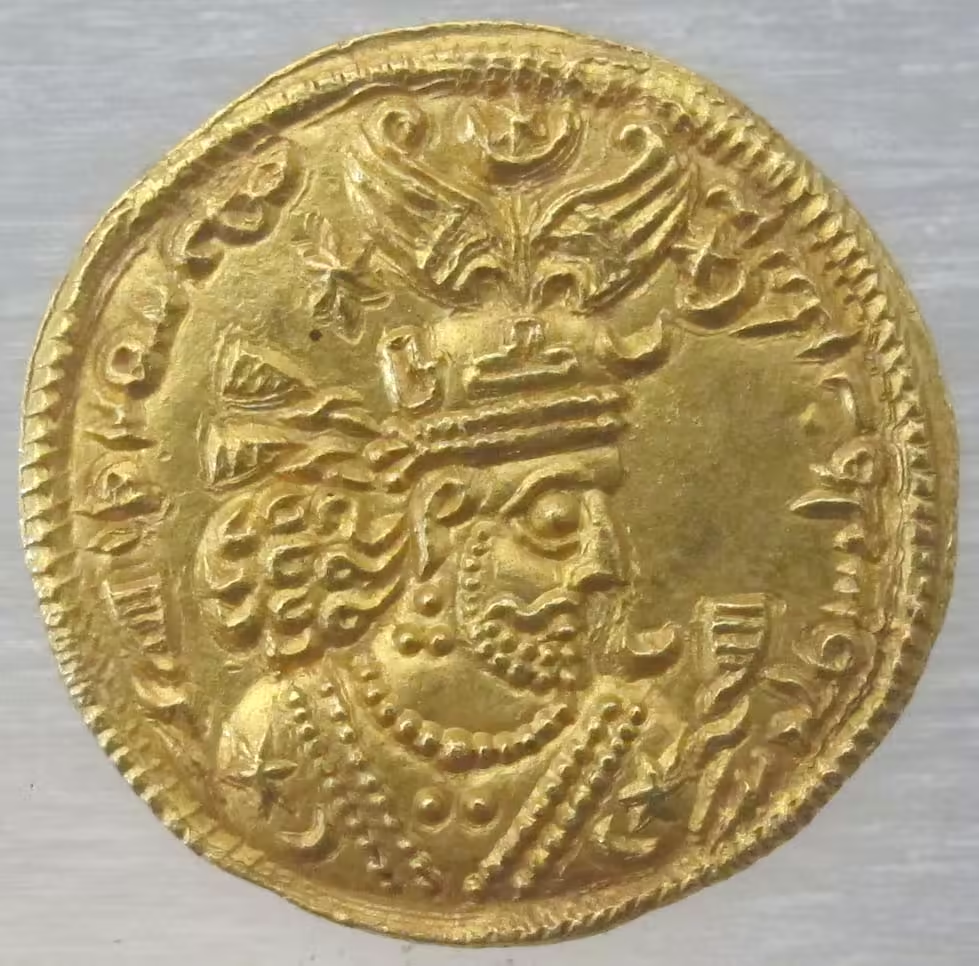
Sasanian coins are the silver drachms, rare gold dinars and copper of the last pre-Islamic Persian empire (224–651 CE): broad thin flans showing the king in a distinctive crown on the obverse and a fire altar with two attendants on the reverse, with Middle Persian (Pahlavi) legends and, from the sixth century, a mint signature and regnal date.
What Sasanian coinage looks like
The defining Sasanian coin is the silver drachm. It is unusually wide and thin for an ancient silver piece — often 28–32 mm across but only about 4 g in weight — which is why edge splits and small chips are normal and not evidence of a fake.
The obverse always carries the king's bust to the right in a personal crown, surrounded by a Pahlavi legend that names him as the Mazda-worshipping divine king of kings. The reverse shows a Zoroastrian fire altar flanked by two attendants, sometimes with a small royal bust in the flames.
Gold dinars follow the same designs and are genuinely rare; copper and billon were struck for local use and survive in poorer condition.
How to identify the ruler from the crown
Sasanian attribution is done by crown type before legend. Ardashir I wears a cap with a korymbos; Shapur I adds a crenellated mural crown; Bahram II appears with his queen and prince; Peroz I wears a double-winged crown; Kavad I and Khosrow I use winged crowns with distinct ornament; Khosrow II adds a double outer border with crescents and stars.
This system exists because the Pahlavi legend is often worn or off-flan. Learning six or seven crowns covers the great majority of coins on the market.
Dating and mint marks
From Kavad I (488–531) the reverse carries a regnal year in the left field and an abbreviated mint signature in the right. Add the regnal year to the king's accession year to get a CE date — a Khosrow I drachm marked year 30 was struck in 560/561 CE.
Common mint abbreviations include WYHC (Veh-Ardashir, near Ctesiphon), BBA (the itinerant court mint), AW (Ahvaz), ST (Istakhr), AT (Adurbadagan), BYS (Bishapur), GD (Gay/Isfahan) and ML (Marw). Mint-and-year collecting is the reason this series is so popular: almost every coin can be placed to a year and a city.
Value, grading and fakes
Worn drachms of Khosrow I, Khosrow II and Peroz I are among the cheapest ancient silver available because they survive in tens of thousands. Premiums attach to early kings (Ardashir I, Shapur I), scarce mints, full unclipped flans with complete borders, and gold.
Cast counterfeits show a soft, grainy surface, rounded letter edges and a seam on the edge; struck fakes usually fail on weight or on a crown that does not match any published type. Because genuine coins are cheap, buying from a specialist dealer is the simplest protection.
The end of the series
After the Arab conquest the drachm did not disappear: Arab-Sasanian issues kept the same crowned bust and fire altar for decades, adding short Arabic phrases such as bismillah in the margin. The break comes with the reform of Abd al-Malik in 696–697 CE, when purely epigraphic Islamic dirhams replaced the imagery entirely.