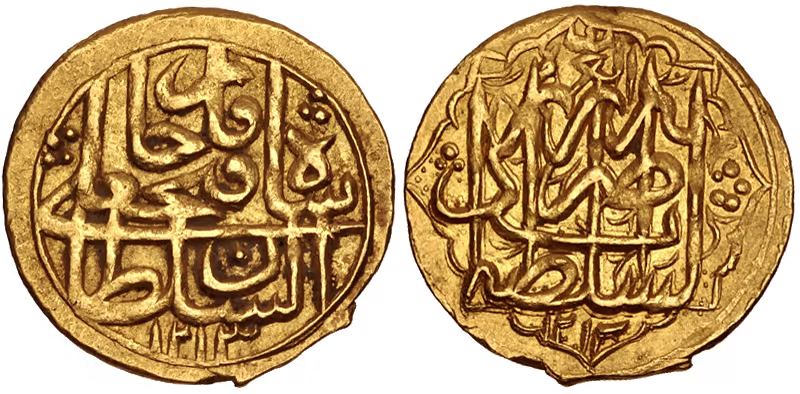
The portrait returns to Iranian coinage
Fath-Ali Shah (1797–1834) put a human figure back on Iranian money for the first time since the Sasanians, showing himself seated in full regalia with his famous long beard on presentation gold. It was a deliberate revival of pre-Islamic royal imagery, and it set the visual grammar of Iranian coinage for the next century.
Under Naser al-Din Shah (1848–1896) the portrait becomes a European-style bust in profile, engraved by or after French and Belgian die-cutters. His long reign produced the bulk of surviving Qajar coinage, in gold, silver and copper, and in a wide range of mints.
The Lion and Sun
The shir-o-khorshid — a lion holding a sword before a rising sun with a human face — appears on the reverse of most Qajar silver and gold, usually within a wreath and surmounted by the Kayanid crown. Its origins are astrological (the sun in Leo) and its adoption as a state emblem is a Qajar consolidation of older Safavid and Timurid usage.
The crown above the lion is a dating aid in itself: the form of the crown, the presence of the sword, and the sun's facial features change measurably across the nineteenth century.
From hammer to machine
Early Qajar coins are hand-struck on irregular flans with off-centre legends — the same technology as Safavid and Zand issues. In 1877 Naser al-Din Shah installed steam-powered presses at Tehran, and the coinage changes completely: perfectly round flans, milled edges, consistent weight, and dies cut in a European engraving idiom.
The machine-struck kran of about 4.6 g became the workhorse coin of late Qajar Iran, joined by 2- and 5-kran pieces. Provincial hand-struck coinage continued briefly at mints such as Herat, Mashhad, Tabriz and Isfahan before Tehran centralised production.
Banknotes and the Imperial Bank
The Imperial Bank of Persia, a British-chartered institution granted a note-issuing concession in 1889, printed the first widely circulating Iranian paper money, denominated in tomans and redeemable only at the branch named on the note.
That branch clause created an accidental collecting field: Tehran and Tabriz notes are the most available, while Yazd, Kermanshah, Bushire and Sultanabad notes are markedly scarcer. Condition dominates value, and cancelled or hole-punched specimens trade well below intact notes.
Value and grading
Machine-struck krans of Naser al-Din and Mozaffar al-Din are common and affordable in circulated grade. Value concentrates in early hand-struck gold, large presentation multiples, scarce provincial mints, and any coin with fully struck-up portrait detail.
Beware cleaned and polished silver — a bright, hairlined surface is the most common problem in this series, and it costs a substantial share of value against an original toned example.