Sources & References
Every catalogue entry cites a primary or scholarly source. This page lists the core literature, online databases and institutional collections underpinning the archive.
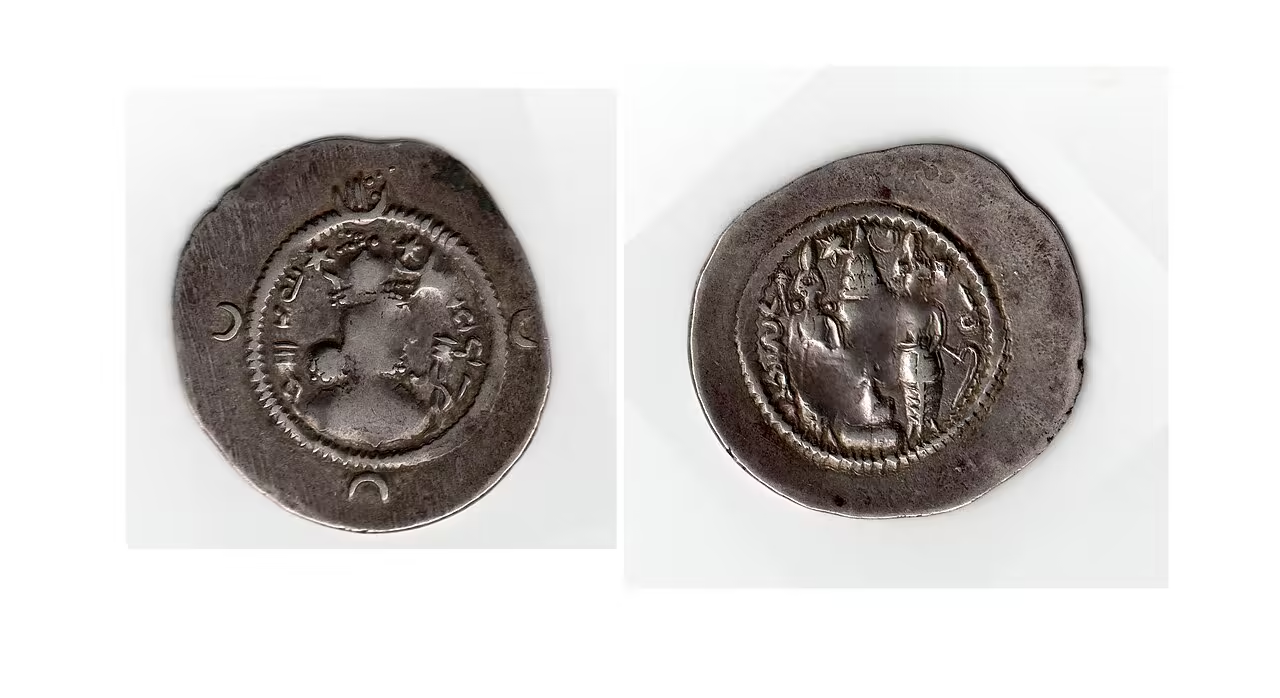
- Sylloge Nummorum Sasanidarum (SNS)Schindel et al., Austrian Academy of Sciences
- Sasanidische NumismatikRobert Göbl, 1971
- An Introduction to the Coinage of the ParthiansDavid Sellwood, 2nd ed. 1980
- A Checklist of Islamic CoinsStephen Album, 3rd ed. 2011
- Standard Catalog of World Coins (Krause)Cuhaj et al., Krause Publications
- Coinage in the Persian EmpireIan Carradice, BM Studies 343, 1987
- American Numismatic Society — Mantisnumismatics.org
- Seleucid Coins OnlineANS / Hellenistic Royal Coinages
- Parthian Empire — Parthia.comEdward C. D. Hopkins (archive)
- British Museum Collection Onlinebritishmuseum.org
- Encyclopædia IranicaEhsan Yarshater Center, Columbia Univ.
- CNG Coin ArchivesClassical Numismatic Group
How to use these sources
Persian numismatic scholarship is unevenly distributed across the eras. For the Achaemenid and Seleucid periods the dominant works are in English and German, published mostly between 1980 and 2010, and almost entirely die-study oriented. For the Parthian period Sellwood's Introduction to the Coinage of the Parthians remains the standard typology more than four decades after the second edition; it has been supplemented but not replaced by online resources such as Edward Hopkins' Parthia.com archive. For the Sasanian period the gold standard is the multi-volume Sylloge Nummorum Sasanidarum produced by the Austrian Academy of Sciences — every catalogue entry on Persian Treasury for this era is cross-referenced to SNS where the type appears.
For Islamic-period coinage Stephen Album's Checklist of Islamic Coins is the indispensable working reference: a single volume covering every Islamic dynasty from the Umayyads to the early modern period, with type numbers that are universally cited in dealer catalogues and auction descriptions. The catalogue numbers (e.g. Album 2275 for a Safavid abbasi of Abbas I) are stable and worth memorising. For specialised Iranian dynasties — Buyid, Ghaznavid, Khwarazmshah — Album points to the deeper monographs (Treadwell on the Buyids, Tye on the Ghaznavids, Vardanyan on the Khwarazmshahs).
Online databases
The American Numismatic Society's Mantis database is the largest single online corpus of Persian and Islamic coins in the public domain. It is searchable by type, mint, ruler and date, and each entry links to high-resolution photographs. The ANS also hosts Seleucid Coins Online, the digital companion to Houghton and Lorber's monumental Hellenistic catalogue. The British Museum's collection database is smaller but particularly strong for Sasanian, Arab-Sasanian, and early Islamic material from the Indian Ocean trading network. Auction archives — CNG, Heritage, Roma Numismatics, Künker — are essential for market values and for tracking newly discovered varieties; we cite specific auction lots where they document a type not yet in the institutional databases.
For the modern period the Central Bank of Iran's Money Museum publishes its own catalogues of Pahlavi and Islamic Republic banknotes and coins, with images and technical specifications. Krause's Standard Catalog of World Coins covers modern Iranian issues in numbered series (KM-#) that are universally cited in collector software. For early 20th-century banknote varieties the standard work is Owen Linzmayer's Banknote Book, available by digital subscription.
Primary sources
Beyond the secondary literature, the most important primary sources for Persian numismatics are the surviving coins themselves and the documentary record of the mints. Achaemenid administrative tablets from Persepolis (the Persepolis Fortification and Treasury archives, published by Hallock and Cameron) record the weights of metal entering and leaving the imperial treasury. Sasanian seals and bullae complement the coins by preserving names, titles and mint cities not always legible on the surviving silver. For the Islamic period the work of medieval Arabic geographers (Ibn Khurradadhbih, al-Istakhri, Ibn Hawqal, al-Muqaddasi) describes the mints in operation in their day; for the Safavid period the European travellers (Chardin, Della Valle, Tavernier) describe Isfahan's mint at work.
For 19th-century Qajar coinage the diplomatic archives of the British, Russian and French legations preserve detailed correspondence on the monetary reforms, the introduction of machine-struck coinage, and the founding of the Imperial Bank. For the 20th century the records of Bank Melli, Bank Markazi and the State Printing House are the principal documentary sources, supplemented by parliamentary debates printed in the official gazette (Ruznameh-ye Rasmi).
Citing Persian Treasury
Persian Treasury is intended to be cited like any other reference work. A suggested form is: Persian Treasury — Persian & Iranian Coins and Banknotes, https://persiantreasury.com, accessed [date]. Individual entries can be deep-linked. We do not require attribution for educational use of short quotations, but ask that derivative works cite the site and provide a return link. For image rights please consult the source link on each catalogue entry — Wikimedia Commons images carry their own licence terms, which we faithfully reproduce.