Bahar Azadi Coin: Iran's Post-1979 Bullion Coin and Monetary Shift
Explore the Bahar Azadi coin, Iran's post-1979 official gold bullion currency. Discover its weight standards, design shifts, and comparison with the Pahlavi gold coinage.
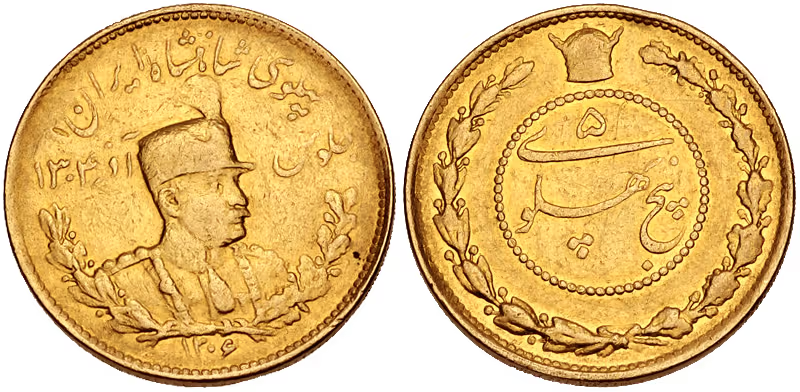
Following the collapse of the monarchy in 1979, the newly established Islamic Republic of Iran confronted an immediate ideological and economic challenge: the purge of imperial monarchical iconography from the national financial architecture. For decades, the gold coinage of Iran had been dominated by the likeness of the ruling monarchs of the Pahlavi dynasty (1925–1979), complete with imperial heraldry, the ancient lion and sun emblem, and royal dates computed according to the Imperial calendar. Re-establishing institutional trust in precious metal reserves required the new government to maintain monetary consistency while radically reconstructing the symbolic language of state-backed specie.
The resulting currency was named the Bahar Azadi (Bahar-e Azadi, literally "Spring of Freedom"), minted by the Security Printing and Minting Organization of the Central Bank of the Islamic Republic of Iran (Bank-e Markazi). By retaining the physical dimensions and metallurgical standards of the preceding imperial coins while replacing monarchical iconography with sacred Shi'ite architectural motifs and calligraphy, the Central Bank created an enduring bullion standard. Decades later, the evolution of the Bahar Azadi coin—specifically the transition from its early non-figural design to the portrait-bearing Emami type—mirrored broader shifts in Iranian political theology, state governance, and traditional family law.
Key facts
- Issuing authority: Central Bank of the Islamic Republic of Iran (Bank-e Markazi).
- First minted: 1979 (Solar Hijri 1358), replacing the gold Pahlavi.
- Gross weight (Full coin): 8.133 grams (0.2615 troy ounces).
- Gold purity: 900 fine (90% gold, 10% copper alloy; 21.6 karats).
- Net pure gold weight: 7.322 grams (0.2354 troy ounces).
- Standard diameter: 22 millimetres with a reeded edge.
- Primary denominations: Quarter (Rob), Half (Nim), Full (Yek), and Multiples (2.5 and 5).
What is the Bahar Azadi coin and how did it originate?
The Bahar Azadi coin emerged in late 1979 as an ideological and economic replacement for the gold Pahlavi coin. When Ruhollah Khomeini (1902–1989) led the Islamic Revolution to victory, deposing Mohammad Reza Shah Pahlavi (reigned 1941–1979), the provisional government faced the immediate task of redesigning the currency. The imperial gold coin had borne the profile of the Shah on the obverse and the Crown of the Pahlavis with the Lion and Sun (Shir-o-Khorshid) on the reverse. Circulating money with such explicit monarchical and secular motifs was deemed incompatible with the doctrine of the nascent Islamic Republic.
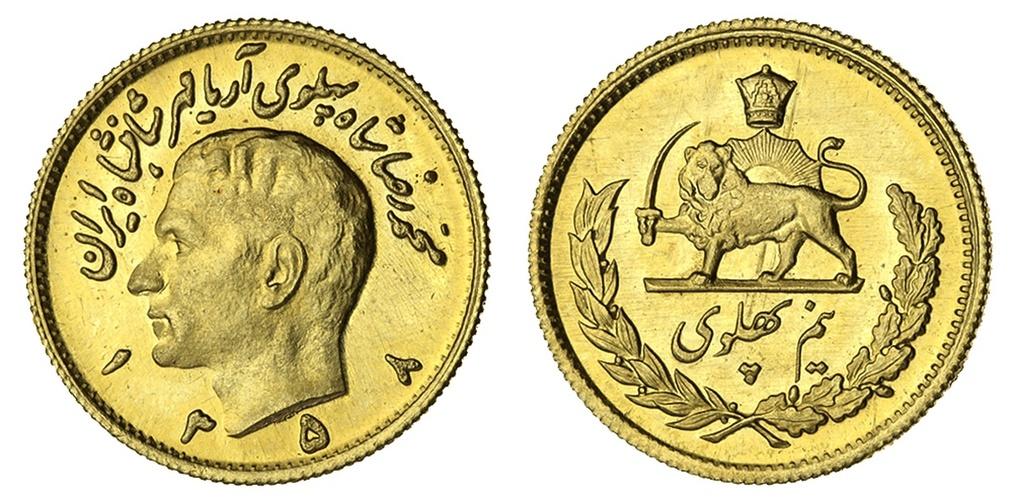
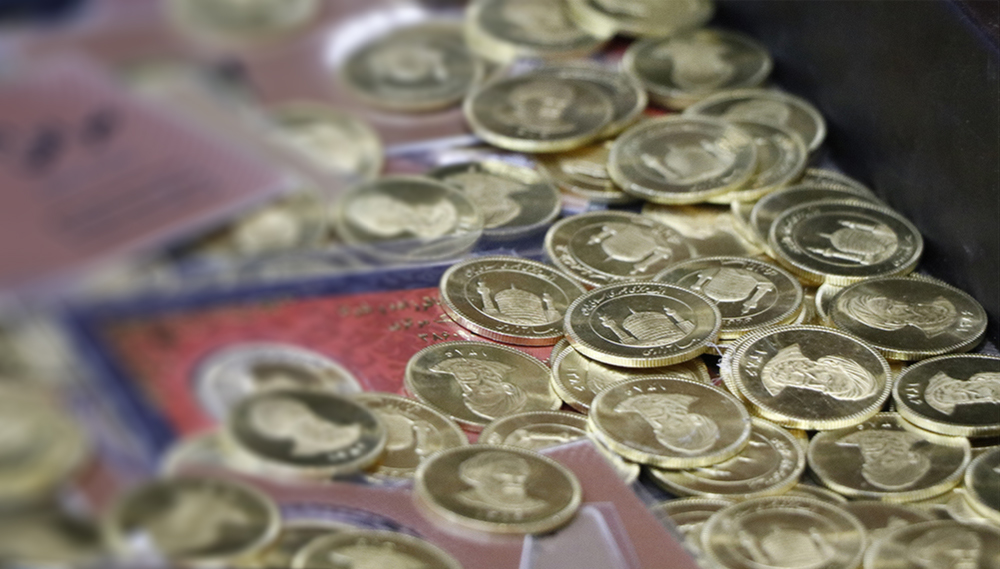
To preserve domestic market confidence, the Central Bank maintained continuity in physical specifications. The bank retained the precise mechanical tolerances, diameter (22 mm), gross weight (8.133 g), and fineness (0.900) of the standard Pahlavi gold coin, which had itself mirrored the weight and fineness of the classic British sovereign (7.988 g of 22k gold) adapted to modern metric tolerances. The inaugural Bahar Azadi coin featured calligraphic compositions invoking the name of Imam Ali along with stylised depictions of the Imam Reza shrine in Mashhad, establishing an explicitly religious visual syntax.
Over the subsequent decades, the Bahar Azadi coin became the central pillar of Iran's non-banking financial system. Rather than circulating as standard transactional currency for everyday goods, it took on the role of a premier inflation hedge, an official gift item for ceremonial occasions like Nowruz (the Persian New Year), and the traditional legal measurement for mehrieh—the mandatory marriage gift owed by a husband to his wife under Islamic civil jurisprudence.
Comparative analysis: Bahar Azadi versus the imperial Pahlavi gold coin
A comparative study of the Bahar Azadi coin and the Pahlavi gold coin demonstrates how two ideologically opposed regimes utilised identical metallurgical templates to convey contrasting political messages. The Pahlavi dynasty, established by Reza Shah Pahlavi in 1925, employed gold coinage to project Western-oriented modernism alongside romanticised pre-Islamic Persian heritage. Coins minted during the reign of Mohammad Reza Shah frequently bore Western-style naturalistic royal portraits, imperial coronation titles (Aryamehr), and solar calendar years, eventually culminating in the controversial 1976 switch to the Imperial calendar (Tarikh-e Shahanshahi) based on Cyrus the Great.
| Attribute | Imperial Pahlavi Gold Coin | Bahar Azadi (Early / Old Design) | Bahar Azadi (Emami Design) |
|---|---|---|---|
| Introduction Year | 1926 (Reza Shah) / 1941 (Mohammad Reza) | 1979 (SH 1358) | 1991 (SH 1370) |
| Obverse Motif | Monarch's profile portrait | Hexagonal calligraphy (Ali) | Portrait of Ruhollah Khomeini |
| Reverse Motif | Lion and Sun beneath Pahlavi Crown | Imam Reza Shrine complex | Imam Reza Shrine complex |
| Weight Standard | 8.133 g (Full Pahlavi) | 8.133 g (Full Coin) | 8.133 g (Full Coin) |
| Gold Fineness | 900/1000 (21.6k) | 900/1000 (21.6k) | 900/1000 (21.6k) |
| Diameter | 22 mm | 22 mm | 22 mm |
| Calendar System | Solar Hijri (later Imperial, 1976–78) | Solar Hijri (Khorshidi) | Solar Hijri (Khorshidi) |
In direct contrast, the post-revolutionary authorities stripped all monarchical and secular nationalistic insignia from the coin. The Lion and Sun—a fixture of Iranian coinage dating back across the Qajar dynasty (1789–1925) and earlier Safavid rulers—was replaced entirely by Shi'ite religious architecture and geometric kufic typography. However, the Central Bank preserved the exact metric standards established under the Pahlavi Monetary Act of 1931. This mechanical continuity ensured that traditional money changers (sarrafs) in the Tehran Grand Bazaar could exchange, test, and trade the new pieces without re-calibrating weight scales or touchstones.
Iconographic evolution: The Old Design (Tarh-e Qadim) versus the Emami (Tarh-e Jadid)
Within the lifespan of the Bahar Azadi coin, a significant stylistic divide exists between the "Old Design" (Tarh-e Qadim) and the "New Design" (Tarh-e Jadid), widely termed the Emami coin.
From 1979 through 1991, the Central Bank struck the Old Design coin exclusively without human figural depiction. Strict interpretations of Islamic visual traditions initially discouraged the placement of political or personal portraits on state coinage. Consequently, the obverse of the Old Design featured an intricate geometric Kufic pattern repeating the name of Ali ibn Abi Talib—the first Shi'ite Imam—inside a hexagon, framed by the Persian inscription Bank-e Markazi-ye Iran (Central Bank of Iran) and Bahar-e Azadi. The reverse showcased the golden dome and minarets of the shrine complex of Imam Ali al-Rida (Imam Reza) in Mashhad, beneath the calligraphic denomination.
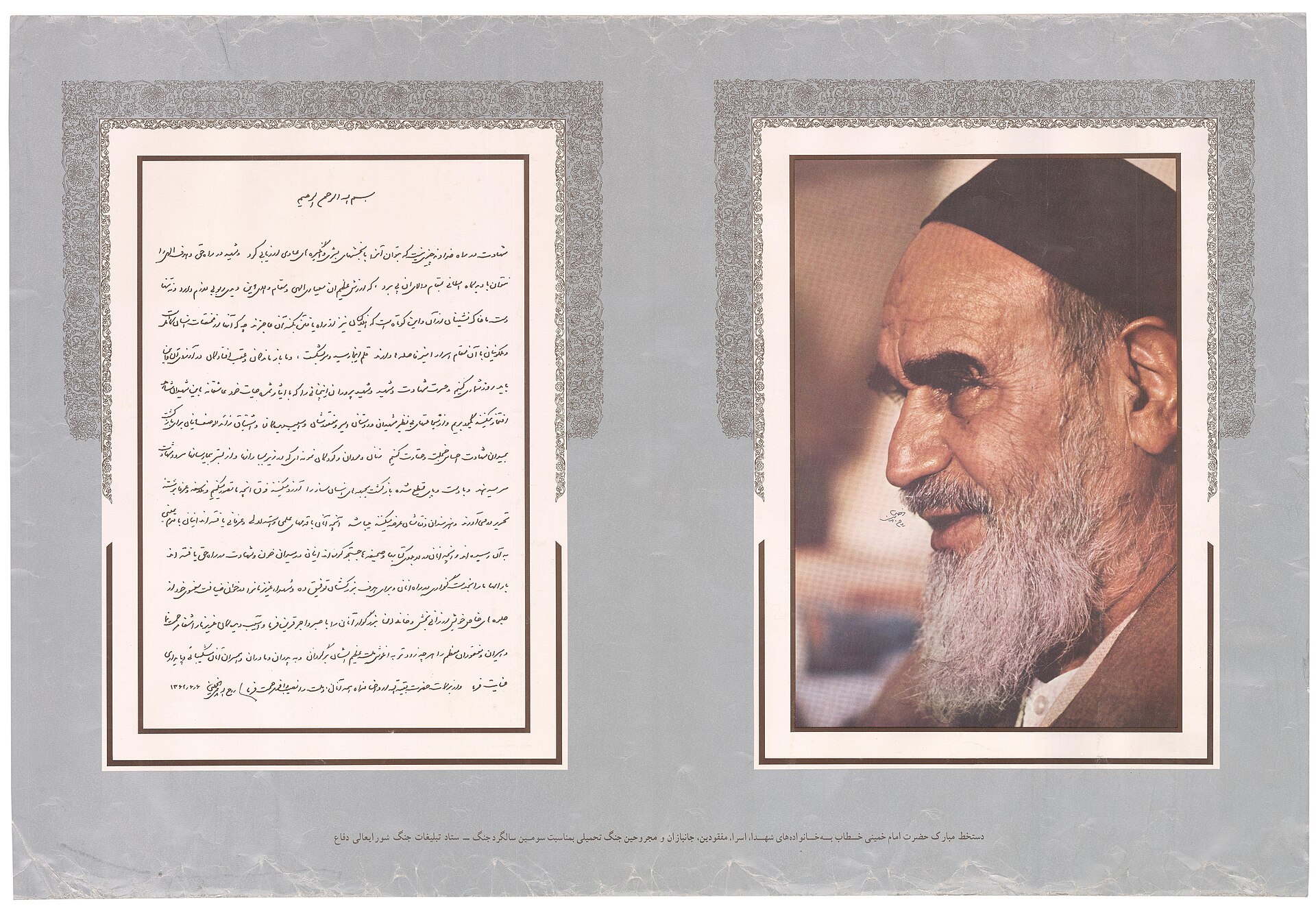
This strict non-figural approach changed fundamentally following the death of the Supreme Leader, Ruhollah Khomeini, in June 1989. In 1991 (Solar Hijri 1370), the Central Bank, authorised by the executive leadership, issued a major redesign: the Emami coin.
- The Obverse Shift: The geometric calligraphy of Ali's name was removed. In its place, the mint engraved a left-facing profile portrait of Ruhollah Khomeini, clothed in his clerical turban and cloak.
- The Reverse Preservation: The reverse preserved the depiction of the Imam Reza Shrine, but the typography and arrangement of the date and denomination were simplified and repositioned.
- Market Reception: The introduction of a portrait on official bullion broke with the initial post-1979 prohibition against figural currency. This aligned modern Iranian bullion with global bullion norms (such as the American Gold Eagle or South African Krugerrand), even as it reintroduced a single leader's visage reminiscent of the Pahlavi-era format.
Denominations, technical standards, and production at the Central Bank of Iran
The production of the Bahar Azadi coin is strictly governed by state regulation under the auspices of the Central Bank of the Islamic Republic of Iran. All genuine bullion coins are struck exclusively at the Security Printing and Minting Organization (Sazman-e Tolid-e Eskenas va Sekkeh), a subsidiary of the Central Bank located in Tehran.
The Central Bank issues the Bahar Azadi in several distinct denominations to facilitate varying levels of capital investment and gift-giving:
- Pents (5 Azadi): Struck intermittently as commemorative presentation pieces; gross weight 40.665 grams.
- Two-and-a-Half (2.5 Azadi): Struck in limited runs; gross weight 20.332 grams.
- Full (Tamam Azadi): The benchmark market coin; gross weight 8.133 grams, 22 mm diameter.
- Half (Nim Azadi): Scaled precisely to half-weight; gross weight 4.066 grams, 19 mm diameter.
- Quarter (Rob Azadi): Scaled to one-quarter weight; gross weight 2.033 grams, 14 mm diameter.
- Germi (One-Gram Coin): Introduced in 2011 to cater to smaller retail budgets; gross weight 1.015 grams of 900 gold, packaged in tamper-evident security blister cards.
The socioeconomic role of the Bahar Azadi in modern Iran
The Bahar Azadi coin occupies a unique position at the intersection of Iranian civil law, household economics, and retail investment. Under the Civil Code of the Islamic Republic of Iran, marital contracts require the groom to pledge a mehrieh—a financial endowment legally claimable by the bride at any point during or after the marriage. Historically pledged in gold misqals or property, the modern Iranian standard shifted almost exclusively to denominations of the Bahar Azadi coin.
Because the Iranian rial (rial) has experienced prolonged periods of inflation and currency devaluation against global fiat reserves, domestic consumers view the Bahar Azadi as the primary domestic liquid store of purchasing power. Families convert excess fiat income into full, half, or quarter Azadi coins through licensed retail sarrafs. Unlike commemorative numismatic medals, the Bahar Azadi operates with very narrow buy-sell spreads relative to the global spot price of gold, transforming it into the de facto sovereign retail investment asset across the country.
Frequently asked questions
What is a Bahar Azadi coin?
The Bahar Azadi coin is the official gold bullion coin of Iran, minted by the Central Bank of the Islamic Republic of Iran since 1979. It features a gold purity of 900 fine (21.6 karats) and an official weight of 8.133 grams for the full denomination, serving as both a national bullion standard and a cultural asset for dowries and savings.
What is the difference between an Emami coin and a Bahar Azadi coin?
The Emami coin is simply the newer design (Tarh-e Jadid) of the Bahar Azadi coin, first minted in 1991. While the original 1979–1991 Bahar Azadi featured Islamic calligraphy of the name of Imam Ali on the obverse, the Emami variant replaced that script with a portrait profile of Ayatollah Ruhollah Khomeini.
How much pure gold is in a full Bahar Azadi coin?
A full Bahar Azadi coin contains precisely 7.322 grams (approximately 0.2354 troy ounces) of pure gold. While the coin has a gross weight of 8.133 grams, it is struck in 900 fine alloy (90% pure gold and 10% copper for mechanical durability).
How does a Bahar Azadi coin differ from an imperial Pahlavi coin?
The Bahar Azadi coin replaced the imperial Pahlavi coin following the 1979 Iranian Revolution, swapping royal imagery for Islamic architecture and portraiture of Ayatollah Khomeini. However, the Central Bank maintained identical physical standards: both coins share an identical gross weight of 8.133 grams, a 22 mm diameter, and a 900 fineness.
Why do many Bahar Azadi coins bear the year 1386?
Many Bahar Azadi coins carry the Solar Hijri year 1386 (corresponding to 2007–2008) because the Central Bank froze the date on dies to curb speculative premiums on newly minted coins. Coins struck by the state mint in subsequent production years continue to display the 1386 year mark.
Where are authentic Bahar Azadi gold coins minted?
Authentic Bahar Azadi coins are minted exclusively by the Security Printing and Minting Organization of the Central Bank of the Islamic Republic of Iran in Tehran. The Central Bank regulates their alloy, edge reeding, and weight tolerances under strict statutory oversight.
Conclusion
The Bahar Azadi coin stands as a fascinating case study in modern numismatics, encapsulating the ideological transformation of Iran following the 1979 revolution. By preserving the technical dimensions of the imperial Pahlavi gold coinage while reimagining its visual and theological iconography, the Central Bank established a stable, universally recognised bullion unit. From the calligraphy-rich Old Design to the Khomeini-portrait Emami issue, the Bahar Azadi bridges centuries of Persian monetary tradition with the realities of modern statecraft, remaining Iran's most vital instrument of wealth preservation and domestic financial life.
Sources & further reading
- Central Bank of the Islamic Republic of Iran (Bank-e Markazi), Tehran. Official Coinage Specifications and Monetary Directives.
- Encyclopædia Iranica. Articles on "Coins and Coinage" and "Pahlavi Dynastic Minting Standards". Columbia University, New York.
- Album, Stephen. Checklist of Islamic Coins. Third Edition, Stephen Album Rare Coins, Santa Rosa.
- American Numismatic Society (ANS). Curatorial Notes on Modern Middle Eastern Bullion and Post-Revolutionary Iranian Specie, New York.
- → Silk Road Monetary Networks: A Collector’s Guide to Sasanian and Samanid Coins
- → Humility in Gold: The Coinage of Karim Khan Zand from Shiraz and Khoy
- → The Isfahan Mint: The Engine of Safavid Prosperity under Shah Abbas I
- → The Dawn of the Modern Rial: Reza Shah and the Transition of Iranian Currency