The Dawn of the Modern Rial: Reza Shah and the Transition of Iranian Currency
This article explores the 1932 transition from the qaran to the rial under Reza Shah Pahlavi, marking a pivotal shift toward nationalized fiscal sovereignty in Iran.
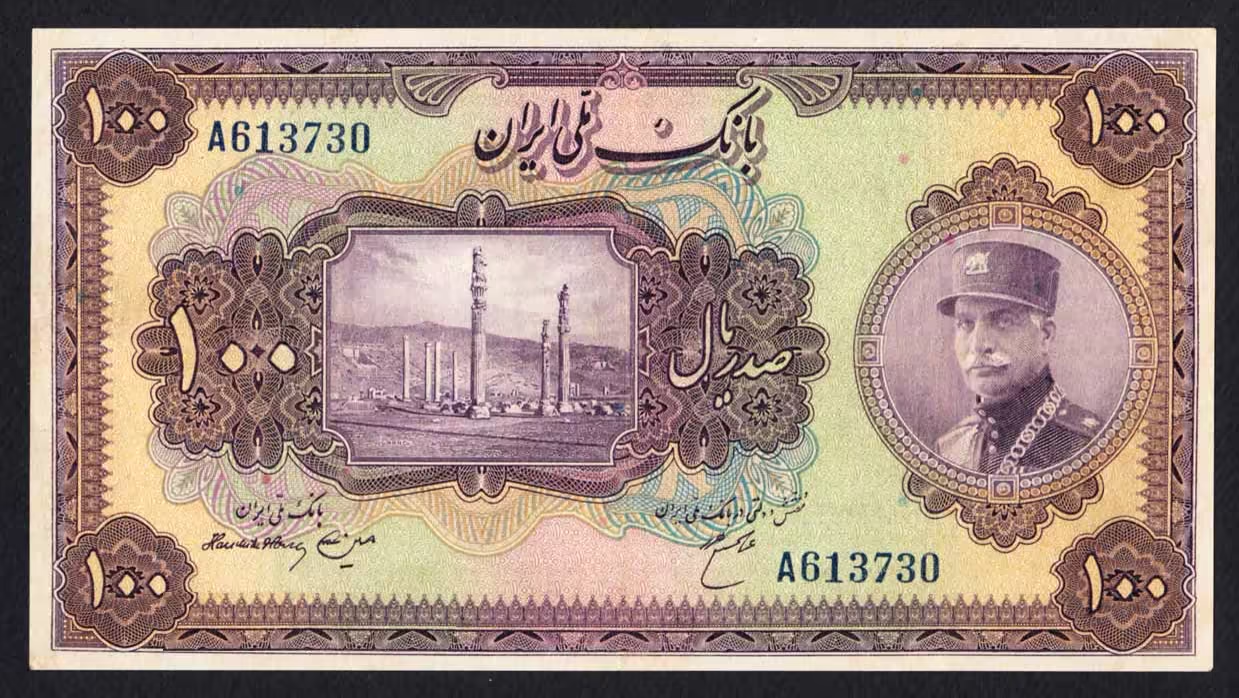
The transition of the Iranian monetary system under the reign of Reza Shah Pahlavi represents more than a mere change in denominations; it was a fundamental component of a broader effort to unify and modernize a nation long fractured by foreign influence and decentralized authority. For centuries, the Persian fiscal landscape was dominated by the qaran and the toman, currencies often influenced by the fluctuating prices of silver and the dictates of foreign-owned financial institutions. In 1932, the enactment of a comprehensive currency reform signaled the birth of the rial as the official unit of the Iranian state. This shift reflected the Pahlavi dynasty’s ambition to establish absolute sovereignty over the domestic economy, replacing colonial-era banking structures with a centralized, state-controlled apparatus that mirrored the industrial and social transformations occurring across the plateau.
The End of the Imperial Bank Era
To understand the magnitude of the 1932 reform, one must first look at the preceding decades of financial administration in Iran. Since the late 19th century, the right to issue banknotes in Persia had been held by the Imperial Bank of Persia, a British-owned institution established under a concession granted to Baron Julius de Reuter. While the Imperial Bank facilitated trade and introduced paper money to a population accustomed to metallic coinage, it remained an instrument of foreign interests. The notes issued by the Imperial Bank were often denominated in tomans and were required to be payable in silver at specific branches, creating a fragmented system where a note issued in Tehran might not be easily redeemed in Tabriz or Mashhad.
Following his coronation in 1926, Reza Shah sought to dismantle these remnants of foreign economic hegemony. The establishment of Bank Melli Iran (the National Bank of Iran) in 1928 was the first decisive step toward this goal. By 1930, the Iranian government successfully negotiated the withdrawal of the Imperial Bank’s exclusive right to issue currency. This paved the way for a truly national system of paper money, one that would be backed by the Iranian state and serviced by a domestic central bank. The subsequent legislation in 1932 officially retired the kran and the toman in favor of the rial, a name derived from the Spanish 'real' which had circulated in the Persian Gulf centuries prior, but which now stood as a symbol of modern Iranian identity.
Design and Iconography of the First Series
The first rial banknotes issued by Bank Melli Iran between 1932 and 1933 were masterpieces of security printing and political messaging. Printed by the American Bank Note Company, these notes featured a layout that departed significantly from the calligraphy-heavy designs of the Qajar era. The most striking feature of the new currency was the portrait of Reza Shah Pahlavi. Unlike previous rulers whose depictions were often stylized or relegated to the reverse of coins, the Shah’s image was placed prominently on the front of every banknote. He was typically depicted in military uniform, wearing the Pahlavi hat (Kolah Pahlavi), symbolizing his role as both a soldier and the supreme disciplinarian of a modernized Iran.
The reverse of these early notes showcased the architectural and historical grandeur of the nation. Images of the ruins of Persepolis, the tomb of Cyrus the Great, and the bridge at Veresk emphasized a bridge between Iran’s glorious pre-Islamic past and its industrial future. These visuals were intended to foster a sense of national pride and continuity. By using motifs from the Achaemenid Empire, the state sought to legitimize the Pahlavi dynasty as the modern successors to the great Persian kings, while simultaneously projecting an image of stability and progress to both the Iranian populace and the international community.
Denominations and the Gold Standard
The 1932 reform introduced a decimalized system where one rial was divided into one hundred dinars. Ten rials formed a 'Pahlavi' in gold, though the rial functioned as the day-to-day unit of account. The first series included denominations of 5, 10, 20, 50, 100, and 500 rials. Each denomination was carefully sized and colored to prevent forgery and to aid a population that was still achieving literacy. The introduction of these notes coincided with a brief and ambitious attempt to peg the Iranian currency to a gold standard, moving away from the silver standard that had historically plagued Iran with inflation during periods of global silver devaluation.
However, the transition was not without its challenges. The shift required a massive logistical effort to withdraw old Imperial Bank notes and replace them with the new Bank Melli issues. The government utilized its growing network of provincial offices and the military to ensure that the new currency reached the farthest corners of the country. For many Iranians in rural areas, the arrival of the new banknotes was their first tangible interaction with the centralized state. The rial became the medium through which taxes were paid, government wages were earned, and the new national economy was integrated. This standardization was essential for the state to fund its massive infrastructure projects, including the Trans-Iranian Railway, without relying on the predatory foreign loans that had crippled the Qajar dynasty.
Security Features and Printing Evolution
As the 1930s progressed, the design and production of the rial notes evolved to reflect technological advancements and the changing political climate. After the initial American-printed series, the Iranian government began to diversify its suppliers, eventually turning to European printers such as Waterlow and Sons in London. These later issues featured more sophisticated security measures, including intricate guilloché patterns, watermarks of the Pahlavi crown or the lion and sun, and advanced ink compositions to deter counterfeiters. The portrait of Reza Shah also aged across subsequent series; the young, stern officer of the early 1930s gave way to a more mature and statesman-like figure in the notes issued toward the end of his reign in 1941.
These technical improvements were mirrored by a shift in the imagery on the reverse of the notes. While the early notes focused on ruins and ancient history, later designs began to incorporate modern achievements. Images of newly built factories, dams, and modern streetscapes in Tehran were used to demonstrate that the Shah’s reforms were yielding concrete results. The banknote had become a portable propaganda tool, a physical manifestation of the "New Iran" that the Pahlavi administration was determined to build. By the time Reza Shah abdicated in 1941, the rial was firmly established as the heart of the Iranian financial system, its presence felt in every marketplace from the Caspian Sea to the Persian Gulf.
The 1932 currency reform remains a landmark event in the history of the Iranian state. By centralizing the issuance of currency and establishing the rial as the national standard, Reza Shah Pahlavi effectively ended the era of foreign monetary control and laid the groundwork for a modern fiscal policy. These banknotes, with their blend of ancient iconography and contemporary military portraiture, serve as a historical record of a nation in the midst of a radical identity shift. The legacy of this period is still visible in the structure of the Iranian banking system today, reminding us that a nation’s currency is never just money, but a reflection of its sovereignty, its history, and its aspirations for the future.